
Platycerium grande (Platycerium grande)
Platycerium grande is a perennial herbaceous fern and is reported to grow as an epiphyte on trunks and branches, as well as on rocks. It grows as a single plant rather than a colony and is a wild species (not a hybrid or cultivar).
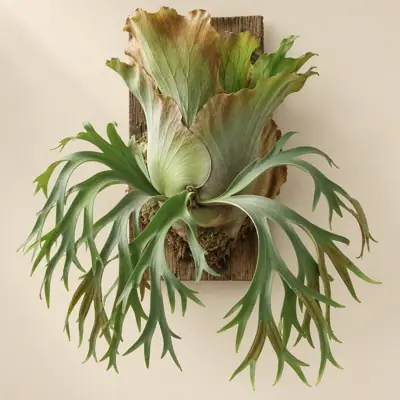
Overview
Platycerium grande is a perennial herbaceous fern and is reported to grow as an epiphyte on trunks and branches, as well as on rocks. It grows as a single plant rather than a colony and is a wild species (not a hybrid or cultivar).
Origin and habitat
Sources differ on its recorded native range: records are concentrated on Mindanao in the Philippines, while a peer-reviewed study reports a wild occurrence in Nantu Forest, Gorontalo Province, Sulawesi, Indonesia. It is a forest epiphyte that naturally grows on trees, with records from forests on Mindanao and from Nantu Forest on Sulawesi. Its environment is tropical, warm, and humid.
Characteristics
It has distinct basal shield fronds that enclose the roots and collect water and organic debris, while the longer fertile fronds extend outward or hang down when mature and develop sporangia on their undersides. The shield fronds are tall and shield-shaped, with deeply divided upper margins and a thin covering of fine hairs. The strap-shaped fertile fronds mostly hang downward and spread outward, developing several main branches at maturity.
Light
Sources differ on direct-light requirements: it is grown with abundant light, with botanical-garden information describing faster growth in full sun, suitability for partial sun, and a need for summer shade, while other staghorn fern cultivation information favors bright, indirect light. It is reported to tolerate some direct sun.
Watering
It is reported to do best when watered thoroughly and the medium is then allowed to dry briefly, avoiding prolonged wetness; watering is more frequent during warm, dry periods and reduced in winter or cooler conditions. Sources are few, but summer watering is reported at about every 2–7 days. Let the root zone dry between waterings.
Humidity and airflow
Platycerium grande prefers high humidity.
Temperature and dormancy
Sources are few, but an ideal temperature range of about 18–35 °C is reported, with about 18 °C as a minimum and about 35 °C as a maximum. It is frost tender; keep above freezing, and it is sensitive to cold but not very sensitive to heat.
Growing medium and mounting
It is reported to suit well-drained epiphytic media such as sphagnum moss and can be secured to boards, tree-fern boards, bark, or baskets; when grown in a pot, a humus-rich, well-drained medium can be used. It is reported to grow on trees (epiphyte), and it suits mounting on a board.
Feeding
A balanced fertilizer can be applied during the growing period, but sources differ on the recommended feeding frequency.
Propagation
Sources differ on propagation details: Platycerium grande can be propagated by spores, is described as having a single growing point and forming offsets infrequently, while spores can be difficult to germinate under natural conditions and in vitro methods such as tissue culture can be used for mass propagation. It is reported to rarely produce offsets. Sori occur in depressions formed by branches of the fertile frond, and the species is commonly propagated by spores.
Common problems
Scale insects and mealybugs are reported to occur in cultivated Platycerium. Anthracnose is reported to occur in cultivated Platycerium. Overwatering is reported to cause rot, insufficient water can cause brown or curled frond tips, and low light may increase pest and disease problems. Platycerium grande does not tolerate cold and needs protection from frost and low temperatures; its tropical origin means it needs warmth in winter, while shade is recommended under strong summer sunlight.
Identification
Platycerium grande is a large staghorn fern with shield-shaped shield fronds and long, hanging fertile fronds at maturity. Sources recorded under the name Platycerium grande (Fée) Kunze also describe a thin covering of fine hairs on the shield fronds and several main branches and multiple sori on the fertile fronds, features that distinguish it from P. superbum.
Photos


Sources
- Wikipedia (en): Platycerium grande — CC BY-SA 4.0 · link
- UF/IFAS Gardening Solutions — Staghorn Ferns: Platycerium (genus-level) — © University of Florida IFAS Extension, facts only · link
- Rainforest Flora care guide: Platycerium (genus-level) — © Rainforest Flora, facts only · link
- 臺北典藏植物園 植物資料庫: Platycerium grande — © 臺北典藏植物園, facts only · link
- NHK みんなの趣味の園芸 植物図鑑: Platycerium (genus-level) — © NHK出版, facts only · link
- Claessen Orchids & Plants: Platycerium grande — © Claessen Orchids & Plants (facts only) · link
- NC State Plant Toolbox: Platycerium (genus-level) — copyright (facts only) · link
- 447 (biologyjournal.brin.go.id) — facts only (§12) · link
- THE NANTU PLATYCERIUM GRANDE (POLYPODIACEAE), A NEW GENERIC RECORD OF PLATYCERIU (karya.brin.go.id) — facts only (§12) · link
- 巨獸鹿角蕨 - PlatyWiki 鹿角蕨百科 (platywiki.org) — facts only (§12) · link
- 巨獸鹿角蕨與巨大鹿角蕨的差異?2 大型鹿角蕨照顧大不同! - 微體溫室 Micro Oasis (micro-oasis.com) — facts only (§12) · link