
elkhorn fern (Platycerium hillii)
Platycerium hillii is reported to be a perennial epiphytic fern that can grow on tree trunks, branches, or rocks and can also be mounted or grown hanging. It is reported to be a cultivar.
Overview
Platycerium hillii is reported to be a perennial epiphytic fern that can grow on tree trunks, branches, or rocks and can also be mounted or grown hanging. It is reported to be a cultivar.
Origin and habitat
Sources differ on its native range, with Australia given in the available account. The genus Platycerium is reported to typically grow as an epiphyte on tree trunks and branches in tropical and subtropical forests and can also grow on rock surfaces. It is reported to prefer warm, humid tropical to subtropical conditions.
Characteristics
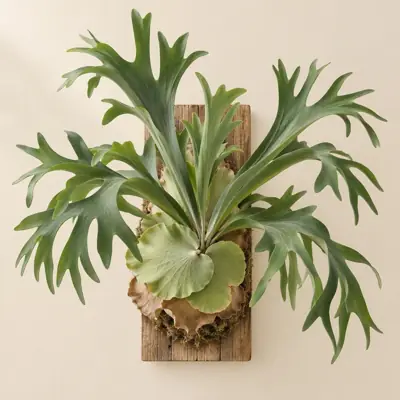
Sources are few, but mature height is reported at about 10–150 cm. It is reported to have distinct frond types: flat, non-reproductive basal shield fronds cover the roots and collect moisture and organic matter, while the more conspicuous fertile fronds may branch or resemble antlers and bear spore cases on their undersides. The shield fronds are reported to be small and flat, covering the roots and forming a nest-like structure that collects moisture and fallen plant debris. The fertile fronds are reported to be long and branched, may resemble antlers, and grow outward and upward.
Light
Sources differ somewhat, but describe bright conditions and recommend bright indirect light or shade to partial shade while avoiding overly strong direct light. It is reported not to tolerate direct sun.
Watering
It is generally recommended to water thoroughly, then allow the growing medium to dry briefly or partially before watering again; water more frequently in warm, dry conditions and less in winter or cool weather, while avoiding prolonged excess moisture that can cause rot. Sources differ, but summer watering is reported at about every 2–7 days. The root zone is generally kept slightly dry.
Humidity and airflow
It generally prefers high humidity and needs good airflow.
Temperature and dormancy
It is reported to be sensitive to cold and not very sensitive to heat. Available reports provide lower and upper temperature limits, but these claims are qualitative and do not establish a numerical range.
Growing medium and mounting
It is reported to be suitable for mounting with sphagnum moss or another moisture-retentive but well-draining medium; when potted, a humus-rich, well-draining medium can be used. It generally grows on trees as an epiphyte and can be mounted, grown in a basket or potted.
Feeding
Sources differ on feeding frequency, but report using a balanced fertilizer, applying dilute fertilizer regularly during the growing season, and reducing feeding in winter.
Propagation
It is reported to be propagated by separating offsets or by spores; separating offsets is easier in home cultivation, while propagation from spores is slower and more difficult. Spores are reported to form in brown patches or spore cases on the undersides of fertile fronds, and propagation from spores is slow and difficult.
Common problems
Scale insects, mealybugs, and aphids are reported as possible pests. Anthracnose may occur, and overwatering may also cause root rot. Overwatering may lead to rot, insufficient water may cause frond tips to brown or curl, and overly strong direct light may bleach or mottle the fronds. It is reported to be sensitive to frost and low temperatures and may require protection or moving indoors in cold conditions.
Identification
Its most conspicuous identifying feature is the presence of distinctly different shield fronds and fertile fronds, with the fertile fronds often forked and antler-like.
Photos


Sources
- Wikipedia (en): Platycerium hillii — CC BY-SA 4.0 · link
- UF/IFAS Gardening Solutions — Staghorn Ferns: Platycerium (genus-level) — © University of Florida IFAS Extension, facts only · link
- Rainforest Flora care guide: Platycerium (genus-level) — © Rainforest Flora, facts only · link
- NHK みんなの趣味の園芸 植物図鑑: Platycerium (genus-level) — © NHK出版, facts only · link
- NC State Plant Toolbox: Platycerium (genus-level) — copyright (facts only) · link