
Platycerium holttumii (Platycerium holttumii)
Platycerium holttumii is a perennial herbaceous fern that grows as an epiphyte, commonly on tree trunks or trees, and can be grown mounted on a board or hanging. It grows as a single plant rather than a colony and is a wild species, not a hybrid or cultivar.
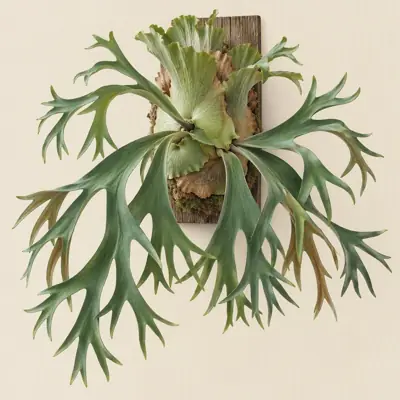
Overview
Platycerium holttumii is a perennial herbaceous fern that grows as an epiphyte, commonly on tree trunks or trees, and can be grown mounted on a board or hanging. It grows as a single plant rather than a colony and is a wild species, not a hybrid or cultivar.
Origin and habitat
Sources differ on its native range; Southeast Asia, including Malaysia, is reported. It is reported to grow as an epiphyte; members of the staghorn fern genus can grow on tree trunks and branches as well as on rocks. It is associated with tropical, warm environments and prefers warm conditions with relatively high humidity.
Characteristics
Its fronds are dimorphic: the shield frond is tall and upright, divided in its upper portion, and appears silvery white because its surface hairs persist, while the fertile frond is a more highly branched strap-like frond whose first fork produces unequal long and short lobes, with the short lobe rising and the long lobe hanging downward. Sources differ in describing its reproductive characteristics; it does not produce typical flowers, reproduces by spores, and spores form on the fertile frond. A single source reports a mature spread of about 100–100 cm; sources are few.
Light
Sources differ on light conditions, describing bright indirect light through partial sun; ample indirect light is associated with faster growth, while summer shade can help avoid leaf damage from strong direct afternoon sun. It tolerates some direct sun.
Watering
After watering, let the growing medium become somewhat dry before watering again, avoiding excessive watering and poor drainage; watering can be reduced in winter. The stated summer watering interval is 2–3, and the stated winter watering interval is 7–7. It is generally recommended to let the root zone dry between waterings.
Humidity and airflow
A single source reports a preferred humidity of about 60–100 %; sources are few. It is generally reported to prefer high humidity and need good airflow.
Temperature and dormancy
A single source reports an ideal temperature range of about 18–27 °C; sources are few. It is sensitive to cold and is generally reported to be not very sensitive to heat.
Growing medium and mounting
For epiphytic cultivation, it is reported to be attachable to a board or similar support, with sphagnum moss or another moisture-retentive yet well-drained medium around the roots; for pot culture, a humus-rich, well-drained medium is recommended. It grows on trees as an epiphyte and is generally reported to suit mounting on a board.
Feeding
Sources differ on feeding practices; a balanced fertilizer can be used, with feeding frequency adjusted according to plant age, season, and cultivation method, and reduced during the cool season.
Propagation
Platycerium holttumii is generally reported to be propagated by spores and, because it has a single growing point, it rarely produces offsets suitable for division.
Common problems
Excessive watering or poor drainage can cause rot, strong direct light can damage the leaves, and cold conditions should be avoided. It is sensitive to cold and needs warmth in winter; summer conditions should combine airflow and shade, and cold drafts should be avoided. In cultivated staghorn ferns, scale insects are reported as a possible problem, and another source mentions mealybugs. Cultivation information for staghorn ferns reports anthracnose as a possible disease, while excessive watering may cause root rot.
Identification
It has a single growing point, tall upright shield fronds with a more silvery appearance from persistent hairs, and highly branched fertile fronds with conspicuously unequal long and short portions after the first fork. It resembles Platycerium wandae but lacks the conspicuous folds at the base of that species' growing point, and its upward-growing fertile frond can branch again.
Photos


Sources
- Wikipedia (en, genus): Platycerium — CC BY-SA 4.0 · link
- UF/IFAS Gardening Solutions — Staghorn Ferns: Platycerium (genus-level) — © University of Florida IFAS Extension, facts only · link
- Rainforest Flora care guide: Platycerium (genus-level) — © Rainforest Flora, facts only · link
- 臺北典藏植物園 植物資料庫: Platycerium holttumii — © 臺北典藏植物園, facts only · link
- NHK みんなの趣味の園芸 植物図鑑: Platycerium (genus-level) — © NHK出版, facts only · link
- Claessen Orchids & Plants: Platycerium holttumii — © Claessen Orchids & Plants (facts only) · link
- NC State Plant Toolbox: Platycerium (genus-level) — copyright (facts only) · link
- Platycerium (wistuba.com) — facts only (§12) · link
- 何其美鹿角蕨 - PlatyWiki 鹿角蕨百科 (platywiki.org) — facts only (§12) · link