
Platycerium quadridichotomum (Platycerium quadridichotomum)
Platycerium quadridichotomum is a wild species (not a hybrid or cultivar) and is reported to be a perennial epiphytic fern that can grow attached to tree trunks and branches or on rocks.
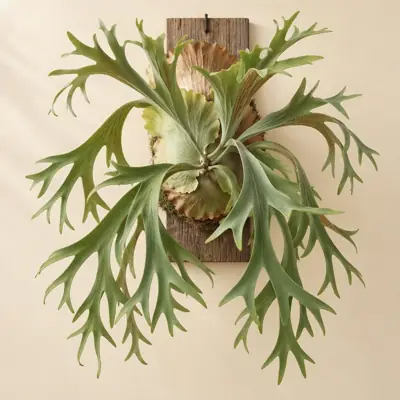
Overview
Platycerium quadridichotomum is a wild species (not a hybrid or cultivar) and is reported to be a perennial epiphytic fern that can grow attached to tree trunks and branches or on rocks.
Origin and habitat
Available sources are reported to support a native range for the genus Platycerium across tropical to some temperate regions of Africa, Madagascar, Asia, Southeast Asia, the Pacific Islands, Australia, New Guinea, and South America, but they do not establish the species-level native range of Platycerium quadridichotomum. Its habitat is reported to be mainly epiphytic, on tree trunks and branches or attached to rocks. Warm, humid tropical environments are reported as typical cultivation and distribution conditions, while some staghorn ferns also occur in temperate regions.
Characteristics
It is reported to have sterile basal shield fronds and fertile fronds: the shield fronds lie against and protect the roots and can collect water and organic debris, while the fertile fronds extend outward or hang down, often fork or form antler-like shapes, and bear sporangia on their undersides. Sources are few, but mature height is reported at about 10–150 cm and mature spread at about 100–100 cm. The shield fronds are reported to be flat, shield-shaped or kidney-shaped and to lie against the tree, protecting the roots while collecting water and fallen plant debris; fertile fronds are reported to fork or become antler-like, extending outward, growing upward, or hanging down, with spores on the lower surface. Species-level quantitative growth-rate data are reported to be unavailable, and cultivation is described as relatively difficult.
Light
Sources describe this differently: ample light is needed, while general Platycerium horticultural sources recommend bright indirect light or partial shade and avoiding very low light. It is reported to tolerate some direct sun.
Watering
Water thoroughly, then let the root zone dry between waterings rather than keeping it continuously wet or overwatering; this species is adapted to a long dry season and dormancy, and some growers let the plant dry between waterings. Sources differ, giving a summer watering interval of about 2–7.
Humidity and airflow
It is reported to prefer moderate humidity. It is also reported to prefer high humidity.
Temperature and dormancy
Sources differ on the minimum temperature requirement. It is reported to be frost tender; keep above freezing, and it is sensitive to cold. It is reported to be not very sensitive to heat.
Growing medium and mounting
For epiphytic cultivation, it can be fixed to a board or similar support with sphagnum moss or another well-drained medium; it is often found on limestone in the wild, but there is insufficient evidence that it prefers an alkaline substrate. It is reported to grow on trees (epiphyte) and to suit mounting on a board.
Feeding
Sources describe this differently: general Platycerium horticultural guidance supports balanced fertilizer, but recommendations for feeding frequency and fertilizer type vary.
Propagation
Platycerium is generally reported to be propagated by spores, while kinds that form offsets or clumps may also be propagated by division or removal of offsets. Spores are reported to form in brown clusters of sporangia on the undersides of fertile fronds and can germinate naturally on surrounding trees under suitable conditions.
Common problems
Scale insects may occur, and Rainforest Flora is also reported to mention mealybugs. Anthracnose may occur, and persistently wet growing medium may cause root rot. Overwatering can cause rot, while excessive dryness may cause brown or curled frond tips; however, curling of the fertile fronds during drought dormancy in Platycerium quadridichotomum is also a natural water-conserving response. Platycerium generally is sensitive to frost and low temperatures, while sources for this species chiefly emphasize its strong adaptation to prolonged drought.
Identification
Its most distinctive reported feature is the combination of basal shield fronds and antler-like fertile fronds, with spores formed in sporangia on the backs of the fertile fronds.
Sources
- Wikipedia (en, genus): Platycerium — CC BY-SA 4.0 · link
- UF/IFAS Gardening Solutions — Staghorn Ferns: Platycerium (genus-level) — © University of Florida IFAS Extension, facts only · link
- Rainforest Flora care guide: Platycerium (genus-level) — © Rainforest Flora, facts only · link
- NHK みんなの趣味の園芸 植物図鑑: Platycerium (genus-level) — © NHK出版, facts only · link
- NC State Plant Toolbox: Platycerium (genus-level) — copyright (facts only) · link
- 四叉鹿角蕨 - PlatyWiki 鹿角蕨百科 (platywiki.org) — facts only (§12) · link