
Ridley's staghorn fern (Platycerium ridleyi)
Platycerium ridleyi is an epiphytic fern that typically grows attached to trees and can also grow on rocks or artificial boards. It is reported to be perennial.
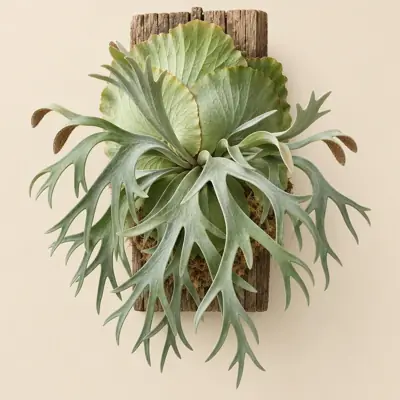
Overview
Platycerium ridleyi is an epiphytic fern that typically grows attached to trees and can also grow on rocks or artificial boards. It is reported to be perennial.
Origin and habitat
The genus Platycerium is reported as native across Africa, Madagascar, Asia and Southeast Asia, Pacific islands, Australia, New Guinea, and South America, while the available sources do not provide a precise native range for Platycerium ridleyi 'Dwarf Silver'. It is an epiphyte of tropical environments, growing attached to other plants without obtaining nutrients from its host; Platycerium is commonly found on trees in natural habitats. The genus is reported mainly from warm, humid tropical environments, although genus-level information also records some kinds in temperate regions.
Characteristics
It has distinct sterile and fertile fronds: basal shield fronds cover the roots and collect water and organic debris, while fertile fronds bear spores; the fertile fronds of Platycerium ridleyi have a pronounced antler-like form with deep divisions. Sources are few, but reported mature height is about 10–150 cm and reported mature spread is about 100–100 cm. The shield fronds are reported to be small and flat, lying against and covering the roots while collecting water and fallen plant debris. Fertile fronds are reported to fork dichotomously or take an antler-like form and may extend outward or hang down from the rhizome.
Light
Sources describe the light requirements differently, but bright indirect light and avoidance of strong direct sunlight are reported. It is reported to not tolerate direct sun.
Watering
It is generally watered by allowing the medium to dry briefly after watering before watering again, while avoiding overwatering; rainwater is reported as a preferred option for Platycerium ridleyi. Sources differ, giving a summer watering interval of about 2–7 days. It is generally recommended to let the root zone dry between waterings.
Humidity and airflow
It is reported to prefer high humidity and to need little air movement. It is generally reported to prefer high humidity.
Temperature and dormancy
Reported temperature information indicates a lower and upper temperature limit without a confirmed numerical range here. It is generally considered sensitive to cold and not very sensitive to heat.
Growing medium and mounting
It is reported to grow epiphytically on boards, fern boards, or bark, with material such as sphagnum around the roots to provide moisture retention and drainage; when grown in a pot, an organic-rich, well-drained sphagnum- or peat-based medium may be used. It grows on trees as an epiphyte and is generally suited to mounting on a board.
Feeding
Sources describe feeding differently: excessive nutrients should be avoided, while Platycerium is reported to receive diluted balanced fertilizer during the growing period with less frequent feeding in winter.
Propagation
Platycerium is reported to be propagated from spores; kinds that form offsets may also be propagated by division or by removing offsets, while propagation from spores is slower and difficult. Spores are reported to form in sporangia on the underside of fertile fronds and, under suitable conditions, may germinate naturally on surrounding trees.
Common problems
Scale insects may occur, and another source also reports mealybugs. Anthracnose is reported as a possible disease, while excessively wet conditions and poor ventilation may increase the risk of disease or rot. Overwatering may cause rot, insufficient water may cause brown or curled frond tips, and excessive shade may increase pest or disease problems; brown sporangia on the underside of fertile fronds are normal reproductive structures rather than disease spots. It is sensitive to cold and frost, and cultivation guidance calls for warm conditions and protection from direct cold drafts.
Identification
Staghorn ferns are reported to be identified principally by their distinct shield fronds and fertile fronds, while Platycerium ridleyi can have clusters of sporangia borne on specialized, stalked frond lobes.
Photos


Sources
- Wikipedia (en, genus): Platycerium — CC BY-SA 4.0 · link
- UF/IFAS Gardening Solutions — Staghorn Ferns: Platycerium (genus-level) — © University of Florida IFAS Extension, facts only · link
- Rainforest Flora care guide: Platycerium (genus-level) — © Rainforest Flora, facts only · link
- NHK みんなの趣味の園芸 植物図鑑: Platycerium (genus-level) — © NHK出版, facts only · link
- Claessen Orchids & Plants: Platycerium ridleyi — © Claessen Orchids & Plants (facts only) · link
- NC State Plant Toolbox: Platycerium (genus-level) — copyright (facts only) · link