
Platycerium willinckii (Platycerium willinckii)
Platycerium willinckii is a perennial epiphytic fern that can grow attached to trunks, branches, or other supports and readily produces offsets that form clumps. It is reported to have a clumping growth habit and to be a cultivar.
Overview
Platycerium willinckii is a perennial epiphytic fern that can grow attached to trunks, branches, or other supports and readily produces offsets that form clumps. It is reported to have a clumping growth habit and to be a cultivar.
Origin and habitat
Sources differ on its native range, with Java in Southeast Asia reported. Platycerium willinckii is native to Java, and members of the genus are generally epiphytes that can naturally grow on trees. It is reported to originate from tropical regions, prefer warm conditions in cultivation, and require warmth in winter.
Characteristics
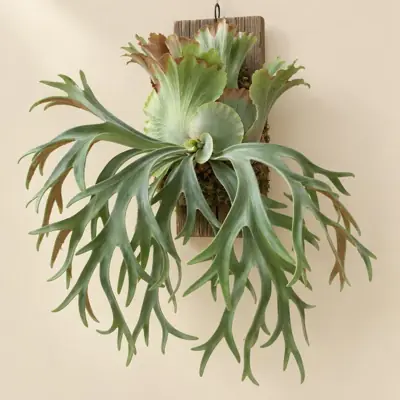
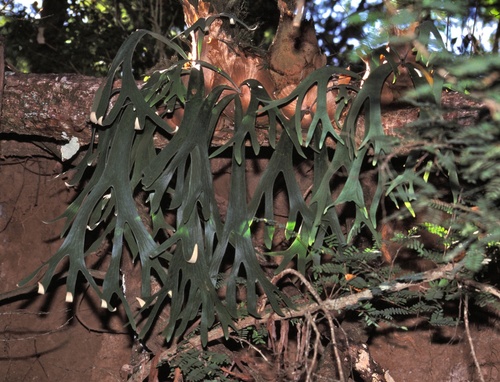
Based on few sources, mature height is about 30–30 cm and mature spread is about 30–30 cm. It is reported to grow quickly and produce offsets more readily when water is plentiful. It has distinct shield and fertile fronds: shield fronds are shield-shaped and attached around the base, while the slender, strap-like fertile fronds hang downward. Shield fronds have fringed lobes and can cover the roots and collect water and fallen plant debris; fertile fronds branch like antlers at their tips, with sori on the undersides at the branching points.
Light
It grows well in bright, abundant indirect light and can tolerate some direct sun, while strong direct sunlight should be avoided and shade provided in summer.
Watering
During active growth it needs ample, steady moisture, but the growing medium can dry slightly before watering again; prolonged excessive moisture can cause rot, and watering should be reduced in winter or cooler conditions. Sources differ, suggesting a summer watering interval of about 2–7 days. It is generally recommended to keep the root zone slightly dry.
Humidity and airflow
It prefers high humidity and needs good airflow.
Temperature and dormancy
Sources differ on its lower temperature limit, while it is reported to have an upper temperature limit; no numerical limits are established here. It is reported to be frost tender and should be kept above freezing; it is sensitive to cold but is reported to be not very sensitive to heat.
Growing medium and mounting
As an epiphyte, it grows on trees and is reported to suit mounting or other attached cultivation, using a medium such as sphagnum moss that retains moisture while draining well; when potted, an organic-rich, well-drained medium is also recommended. It is reported to be suitable for mounting, basket culture, or potting.
Feeding
Sources differ on feeding frequency, but balanced fertilizer is recommended.
Propagation
It can be propagated by dividing offsets or from spores, and plentiful water encourages its clumping growth to produce offsets more readily. It is reported to often produce offsets. Sori are reported to develop on the undersides of the antler-like branching points near the tips of fertile fronds.
Common problems
Members of the genus are reported to be susceptible to scale insects, mealybugs, and aphids. Anthracnose may occur, and overwatering may cause root rot or other rot; insufficient water may cause frond tips to brown or curl, while low light may increase pest and disease problems. It is sensitive to cold and frost and needs warmth in winter; in hot summer conditions, airflow and shade are important.
Identification
'Jade Girl' is a very small staghorn fern cultivar with a conspicuous white, powdery appearance on its fronds; its Platycerium willinckii background is characterized by slender, hanging fertile fronds, shield-shaped shield fronds, and a tendency to produce offsets and form clumps.
Photos


Sources
- Wikipedia (en, genus): Platycerium — CC BY-SA 4.0 · link
- UF/IFAS Gardening Solutions — Staghorn Ferns: Platycerium (genus-level) — © University of Florida IFAS Extension, facts only · link
- Rainforest Flora care guide: Platycerium (genus-level) — © Rainforest Flora, facts only · link
- 臺北典藏植物園 植物資料庫: Platycerium willinckii — © 臺北典藏植物園, facts only · link
- NHK みんなの趣味の園芸 植物図鑑: Platycerium (genus-level) — © NHK出版, facts only · link
- NC State Plant Toolbox: Platycerium (genus-level) — copyright (facts only) · link
- Platycerium bifurcatum ssp. willinckii 'Jade Girl' - – Jungle Leaves (www.jungle-leaves.de) — facts only (§12) · link
- 444428743.pdf (acac.niu.edu.tw) — facts only (§12) · link
- 侏儒爪哇鹿角蕨 cv. '玉女' (P. willinckii dwarf cv. 'Jade Girl') - PlatyWiki 鹿角蕨百科 — facts only (§12) · link
- 侏儒爪哇鹿角蕨 cv. 'OMG' (P. willinckii dwarf cv. 'OMG') - PlatyWiki 鹿角蕨百科 — facts only (§12) · link
- 侏儒爪哇鹿角蕨 cv. '金童' (P. willinckii dwarf cv. 'Golden Boy') - PlatyWiki 鹿角蕨百科 — facts only (§12) · link
- 爪哇鹿角蕨 - PlatyWiki 鹿角蕨百科 — facts only (§12) · link
- 鹿角蕨 - PlatyWiki 鹿角蕨百科 — facts only (§12) · link
- Platycerium willinckii 'Jade Girl' 玉女:養護與辨識 · 鹿的手手 LDS² — facts only (§12) · link