
Platycerium willinckii (Platycerium willinckii)
Platycerium willinckii is a perennial herbaceous epiphytic fern that can grow attached to tree trunks, branches, rocks, or artificial boards. It is generally reported to have a clumping growth habit.
Overview
Platycerium willinckii is a perennial herbaceous epiphytic fern that can grow attached to tree trunks, branches, rocks, or artificial boards. It is generally reported to have a clumping growth habit.
Origin and habitat
Platycerium willinckii is reported to be native to Java in Southeast Asia. It is an epiphytic fern; in natural settings, members of the staghorn fern genus can grow on trees or rocks. It is native to tropical regions, favors warm conditions, and needs protection from winter cold.
Characteristics
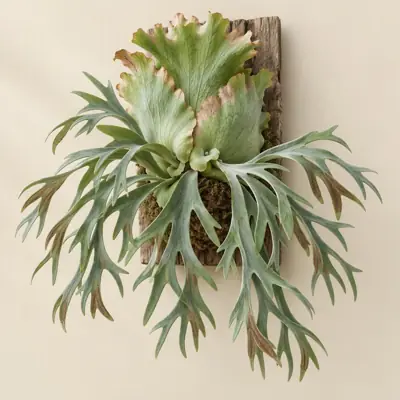
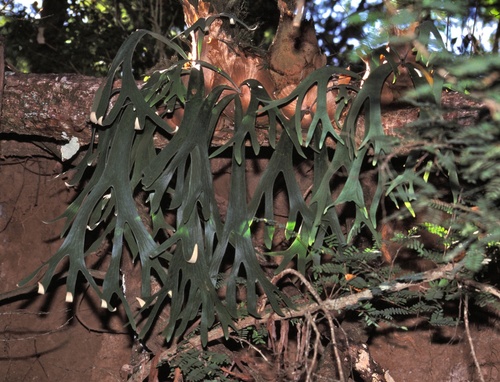
Few-source information reports a mature height of about 10–150 cm and a mature spread of about 100–100 cm. It is reported to grow quickly when water is sufficient and to produce offsets more readily under these conditions. It has distinct shield and fertile fronds: shield fronds lie against the base, are often green to yellowish brown, and have fringed lobes along their margins, while fertile fronds are narrow, strap-shaped, pendent, and hairy on both surfaces, with the hairs more conspicuous on young fronds and becoming sparser as they mature. The shield fronds are shield-shaped and lie against the base with fringed marginal lobes, while the fertile fronds are strap-shaped and pendent, ending in antler-like forks.
Light
Bright, abundant indirect light is suitable, and it can also grow with partial sun; in summer it needs shade and good airflow. It is generally reported to tolerate some direct sun.
Watering
Provide sufficient water during active growth, but use a well-draining medium and let the root zone dry slightly between waterings; prolonged excess moisture can cause rot, and watering should be reduced in winter or during colder, cloudy conditions. Sources differ on summer watering, with the limited information suggesting about every 2–3 days. Few-source information suggests winter watering at about every 7 days.
Humidity and airflow
It is generally reported to prefer moderate humidity. It needs good airflow. It is generally reported to prefer high humidity.
Temperature and dormancy
Sources differ on its minimum and ideal temperature conditions. A single source reports an upper temperature condition without a confirmed numeric value here. It is generally reported to be frost tender; keep above freezing, and it is sensitive to cold. It is generally reported to be not very sensitive to heat.
Growing medium and mounting
It is reported to grow well mounted on wood, tree-fern board, or another epiphytic support with sphagnum moss or another moisture-retentive but well-draining medium; when potted, a humus-rich, well-draining medium is recommended. It is generally reported to grow on trees as an epiphyte and can be mounted, grown in a basket, or potted.
Feeding
Sources differ on feeding details, but balanced fertilizer can be used; feeding is more frequent during active growth and reduced in winter, while mature plants may need less frequent feeding.
Propagation
Platycerium willinckii can be propagated by dividing offsets or young plants; staghorn ferns can also be propagated from spores, though division is easier in home cultivation, and this species readily produces offsets and forms clumps. It is generally reported to often produce offsets. The spore-producing clusters are reported to occur on the underside of the antler-like forks at the ends of fertile fronds.
Common problems
Scale insects, mealybugs, and aphids are reported as possible pests. Anthracnose may occur, and overwatering may lead to root rot. Overwatering may cause rot, insufficient water may cause brown or curled frond tips, and low light may increase pest and disease problems. It does not tolerate cold and needs protection from frost; in winter it should be kept warm, while summer conditions call for airflow and moderate shade.
Identification
Platycerium willinckii is reported to have proportionally narrow, pendent fertile fronds, shield-shaped shield fronds with fringed marginal lobes, and a tendency to produce offsets and form clumps.
Photos


Sources
- Wikipedia (en, genus): Platycerium — CC BY-SA 4.0 · link
- UF/IFAS Gardening Solutions — Staghorn Ferns: Platycerium (genus-level) — © University of Florida IFAS Extension, facts only · link
- Rainforest Flora care guide: Platycerium (genus-level) — © Rainforest Flora, facts only · link
- 臺北典藏植物園 植物資料庫: Platycerium willinckii — © 臺北典藏植物園, facts only · link
- NHK みんなの趣味の園芸 植物図鑑: Platycerium (genus-level) — © NHK出版, facts only · link
- NC State Plant Toolbox: Platycerium (genus-level) — copyright (facts only) · link
- 侏儒爪哇鹿角蕨 cv. '玉女' (P. willinckii dwarf cv. 'Jade Girl') - PlatyWiki 鹿角蕨百科 — facts only (§12) · link
- 侏儒爪哇鹿角蕨 cv. 'OMG' (P. willinckii dwarf cv. 'OMG') - PlatyWiki 鹿角蕨百科 — facts only (§12) · link
- 侏儒爪哇鹿角蕨 cv. 'Nano' (P. willinckii dwarf cv. 'Nano') - PlatyWiki 鹿角蕨百科 — facts only (§12) · link
- 爪哇鹿角蕨 - PlatyWiki 鹿角蕨百科 — facts only (§12) · link
- 鹿角蕨 - PlatyWiki 鹿角蕨百科 — facts only (§12) · link
- Platycerium willinckii 'Jade Girl' 玉女:養護與辨識 · 鹿的手手 LDS² — facts only (§12) · link
- Platycerium willinckii 'Nano' Nano:養護與辨識 · 鹿的手手 LDS² — facts only (§12) · link
- Platycerium willinckii 'Jenny' 珍妮:養護與辨識 · 鹿的手手 LDS² — facts only (§12) · link