
coleus (Plectranthus scutellarioides)
Plectranthus scutellarioides is an upright to clumping herbaceous or semi-shrubby foliage plant whose base can become woody. It is perennial and evergreen, but is also commonly grown as an annual and may be a short-lived perennial.
Overview
Plectranthus scutellarioides is an upright to clumping herbaceous or semi-shrubby foliage plant whose base can become woody. It is perennial and evergreen, but is also commonly grown as an annual and may be a short-lived perennial.
Origin and habitat
Sources differ on the details of its native range, describing it broadly from tropical to subtropical Asia southward to New Guinea and northern Australia. It occurs in habitats including rainforest, forest, stream and waterway banks, shrubland, limestone hills, secondary forest, rice-field margins, and disturbed areas, from lowlands to mountainous areas. It is native to tropical and subtropical climates and is suited to warm conditions; in colder regions it is commonly grown in containers or as an annual ornamental.
Characteristics
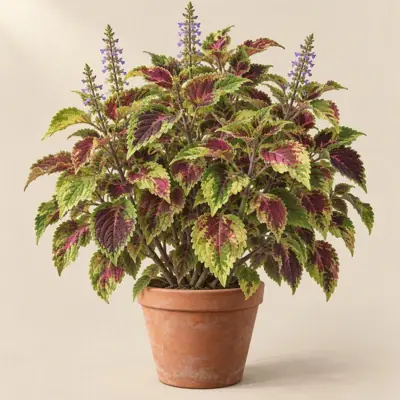
Sources differ on mature height, reporting about 30–150 cm, while mature spread is 60–91 cm. Leaves are opposite and usually ovate to heart-shaped, with margins varying in the degree of teeth or lobing and surfaces that may be hairy; cultivated forms have highly variable foliage colors and patterns, including green, white, cream, yellow, pink, red, and purplish brown. Small flowers are borne in terminal inflorescences, with a typically two-lipped corolla in blue, blue-purple, purple, or pink, and flowering occurs from summer to autumn. It is reported to form small segmented fruits, described as black and nutlet-like.
Light
Partial shade to bright conditions are more suitable, although the plant can also adapt to full shade or sun; intense full sun may cause wilting, while insufficient light may lead to elongated growth and cause colorful variegation to turn green.
Watering
It prefers moist conditions and moist but well-drained soil.
Temperature and dormancy
A single source reports a lower-temperature threshold for the plant. With few sources available, the reported ideal temperature range is about 15–30 °C.
Growing medium and mounting
Moist, fertile, loose, well-drained soil is preferred, although the plant can adapt to a wider range of soil conditions.
Propagation
It can be propagated from seed or stem cuttings; cuttings root readily in water or clean growing medium. Seeds can be sown in spring and are reported to germinate after a short period.
Common problems
It is reported to be susceptible to whiteflies, aphids, and two-spotted spider mites. Strong sunlight may cause wilting, excessive shade may produce elongated growth, insufficient light may cause colorful leaf patterns to turn green, and low temperatures inhibit growth. It is sensitive to frost and low temperatures, tolerating only very occasional light frost, and growth stops below a low-temperature threshold.
Identification
Its main ornamental feature is its highly varied foliage colors and patterns; the stems are usually well branched and can gradually become woody from the base, while cultivated varieties vary greatly in leaf shape, margins, and color combinations.
Photos


Sources
- Wikipedia (en): Coleus scutellarioides — CC BY-SA 4.0 · link
- 維基百科:彩葉草 — CC BY-SA 4.0 · link
- Wikipedia (de): Buntnessel — CC BY-SA 4.0 · link
- Wikipedia (es): Plectranthus scutellarioides — CC BY-SA 4.0 · link
- GBIF descriptions: Catálogo de Plantas y Líquenes de Colombia; Chapter 7: Linnaean Plant Names and their Types (part O) — per dataset · link
- NC State Plant Toolbox: Plectranthus scutellarioides — copyright (facts only) · link
- 農業知識入口網 植物圖鑑: Plectranthus scutellarioides — © MOA, facts only · link
- Useful Tropical/Temperate Plants: Plectranthus scutellarioides — CC BY-NC-SA 3.0 (facts only) · link
- USDA PLANTS Database: Plectranthus scutellarioides — Public domain (US Government work) · link