
templetree (Plumeria rubra)
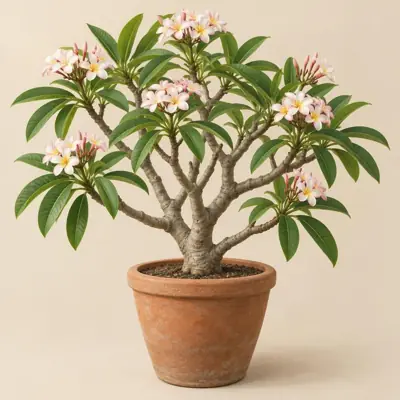
Plumeria rubra is a deciduous shrub to small tree or tree, with somewhat succulent branches and a potentially broad-spreading crown. It is a perennial and is usually deciduous, although sources describe its life cycle differently.
Overview
Plumeria rubra is a deciduous shrub to small tree or tree, with somewhat succulent branches and a potentially broad-spreading crown. It is a perennial and is usually deciduous, although sources describe its life cycle differently.
Origin and habitat
Sources differ on the native range: it is centered on Mexico and Central America through Colombia and Venezuela in northern South America, while some sources extend it to Peru or the West Indies. Natural habitats include hot, dry areas, dry rocky lowlands, forests, hillsides, and tropical dry forest. It is adapted to warm tropical to subtropical climates, especially hot environments with a distinct dry season or moderate rainfall, and is widely cultivated in tropical and subtropical regions worldwide.
Characteristics
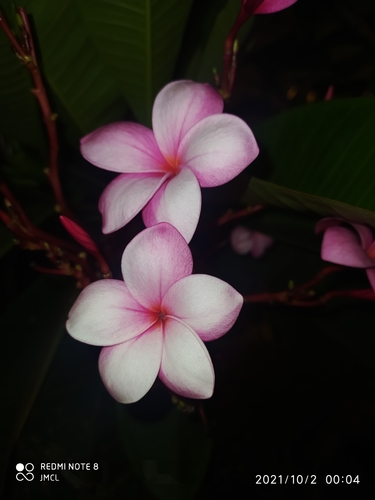
Sources differ, but mature height is about 500–1200 cm, and the few sources on mature spread differ, giving about 700–800 cm. Growth is slow, and the leathery simple leaves cluster at branch tips in alternate or spiral arrangements, varying from elongate-elliptic and lanceolate to obovate forms and potentially falling in winter. Sources differ in their flower descriptions and flowering period: the strongly fragrant flowers have a pinwheel-like, overlapping corolla; wild forms are commonly white to pale pink with yellow centers, while cultivated forms may be white, yellow, pink, red, or multicolored, and flowering occurs mainly from spring through autumn, especially in summer and autumn, with a potentially longer period in warm regions. The fruits are slender paired follicles containing many winged seeds, and fruiting may be less common on cultivated plants.
Light
Plumeria rubra prefers full sun, and insufficient sunlight reduces flowering.
Watering
It is drought tolerant and benefits from a well-drained growing medium; provide moderate water during growth while avoiding prolonged wetness, and greatly reduce watering when leaves fall or during dormancy in winter.
Temperature and dormancy
The few sources differ on minimum temperature, indicating about 10 °C. Sources differ on the hardiness classification, while the plant is frost tender and should be kept above freezing.
Growing medium and mounting
It adapts to various soils but does best in fertile, well-drained soil; it can grow in sandy or loamy soil and tolerate acidic, neutral, or alkaline conditions.
Feeding
Organic fertilizer can be used to promote growth in spring and autumn, while RHS greenhouse guidance recommends balanced liquid fertilizer regularly during the growing season.
Propagation
Plumeria rubra can be propagated by cuttings or seed; mature shoot tips can be used as cuttings after allowing the milky sap at the cut surface to dry, then placing them in a well-drained medium. Seed propagation is also possible but is used more commonly for breeding.
Common problems
It is reported to be susceptible to plumeria rust caused by Coleosporium plumeriae, with infected leaves developing brown-orange powdery spots or film-like symptoms. Insufficient sunlight can lead to sparse flowering, the growing medium should not remain wet for prolonged periods, and the fleshy, relatively brittle branches release milky sap when broken. It is sensitive to frost and low temperatures and needs frost protection in cold areas; its fleshy branches are relatively brittle, and elongated branches on container-grown plants can create a risk of toppling in strong winds.
Identification
Plumeria rubra has thick, somewhat succulent and brittle branches that can release white milky sap when broken, leaves clustered at branch tips, and fragrant flowers with a conspicuous pinwheel-like overlapping appearance and commonly yellow centers.
Photos


Sources
- Wikipedia (en): Plumeria rubra — CC BY-SA 4.0 · link
- Wikipedia (ja): インドソケイ — CC BY-SA 4.0 · link
- Wikipedia (de): Rote Frangipani — CC BY-SA 4.0 · link
- Wikipedia (fr): Plumeria rubra — CC BY-SA 4.0 · link
- Wikipedia (es): Plumeria rubra — CC BY-SA 4.0 · link
- GBIF descriptions: Checklist of introduced taxa in Cyprus; Especies presentes en el catálogo virtual del Tropicario del — per dataset · link
- Wikipedia (it): Plumeria rubra — CC BY-SA 4.0 · link
- Wikipedia (pt): Jasmim-manga — CC BY-SA 4.0 · link
- TaiCOL 臺灣物種名錄: Plumeria rubra — CC BY 4.0 · link
- 農業知識入口網 植物圖鑑: Plumeria rubra — © MOA, facts only · link
- Useful Tropical/Temperate Plants: Plumeria rubra — CC BY-NC-SA 3.0 (facts only) · link
- RHS Plants: Plumeria rubra — © RHS, facts only · link
- USDA PLANTS Database: Plumeria rubra — Public domain (US Government work) · link
- Top Tropicals catalog: Plumeria rubra — © Top Tropicals LLC (facts only) · link