
Ming aralia (Polyscias fruticosa)
Polyscias fruticosa is a perennial evergreen shrub to small tree with an upright, well-branched habit.
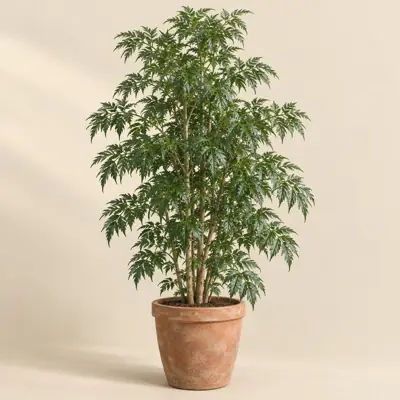
Overview
Polyscias fruticosa is a perennial evergreen shrub to small tree with an upright, well-branched habit.
Origin and habitat
Sources differ on its native range, describing the western Pacific and, more specifically, Sulawesi and the Maluku Islands in Indonesia, New Guinea, and northeastern Australia. It is mainly associated with moist tropical biomes and is now widely cultivated in tropical regions. It is associated with warm, humid tropical to subtropical climates.
Characteristics
Sources differ, with the few available accounts placing mature height at about 300–500 cm; growth is slow. The alternate leaves are finely divided compound leaves, typically tripinnate but sometimes more highly divided; the narrow ovate to lanceolate leaflets are glossy dark green above and paler beneath, with serrated or lobed margins, and some plants have red petioles, leaf axes, and leaflet stalks. The small, inconspicuous, pale yellow to white flowers are reported to form terminal or axillary umbels or panicles, with small petals on each flower. Sources differ on flowering, describing flowering during warm, humid months in tropical environments or throughout the year in cultivation; they also differ in describing the small spherical to ovoid drupes, which mature from green to purple-black or dark brown and generally contain few seeds.
Light
Polyscias fruticosa does well in bright indirect light, bright shade, or partial sun; indoors, strong direct sunlight should be avoided.
Watering
The growing medium is generally kept moderately moist without becoming waterlogged, allowing the surface to dry before watering again and avoiding prolonged excessive wetness or dryness.
Temperature and dormancy
Polyscias fruticosa is reported to suit warm conditions within its stated USDA hardiness range.
Growing medium and mounting
It adapts to various soils provided they are well drained, while another source indicates a preference for well-drained acidic soil.
Propagation
Stem cuttings are reported to be a common propagation method, while seed germination is low.
Common problems
Reported pests include aphids, scale insects, mealybugs, whiteflies, mites, and nematodes, with mites more likely in dry conditions. Root rot is reported to occur when soil is waterlogged or remains excessively moist. Dry conditions are also reported to favor mites. The plant prefers warm conditions, and strong sun exposure should be avoided for container-grown plants.
Identification
Its main distinguishing feature is the finely divided, fern-like, multiply pinnate foliage, with irregularly lobed and serrated leaflets forming a dense, delicate, feathery crown.
Photos


Sources
- Wikipedia (en): Polyscias fruticosa — CC BY-SA 4.0 · link
- 維基百科:裂葉福祿桐 — CC BY-SA 4.0 · link
- Wikipedia (fr): Polyscias fruticosa — CC BY-SA 4.0 · link
- GBIF descriptions: Lista de especies de plantas exóticas y trasplantadas de Colombia; Catálogo de Plantas y Líquenes de — per dataset · link
- NC State Plant Toolbox: Polyscias fruticosa — copyright (facts only) · link
- Useful Tropical/Temperate Plants: Polyscias fruticosa — CC BY-NC-SA 3.0 (facts only) · link
- USDA PLANTS Database: Polyscias fruticosa — Public domain (US Government work) · link