
shield aralia (Polyscias scutellaria)
Polyscias scutellaria is an evergreen, much-branched shrub or small tree that can also be grown as an indoor foliage plant. It is reported to be perennial.
Overview
Polyscias scutellaria is an evergreen, much-branched shrub or small tree that can also be grown as an indoor foliage plant. It is reported to be perennial.
Origin and habitat
Sources differ on its native range, describing it broadly from Southeast Asia to New Guinea and the western Pacific, including the eastern Malay Archipelago. In New Guinea it occurs at lower elevations, and it is also widely cultivated in gardens, as hedges, and as an ornamental plant. It is a tropical plant suited to warm conditions and does not tolerate frost or freezing.
Characteristics
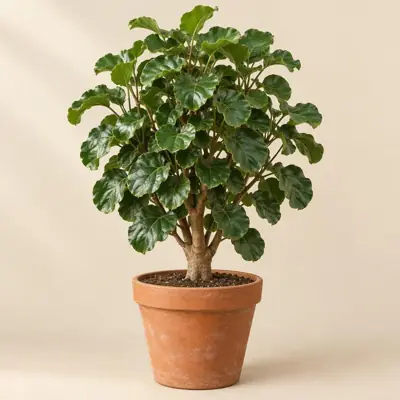
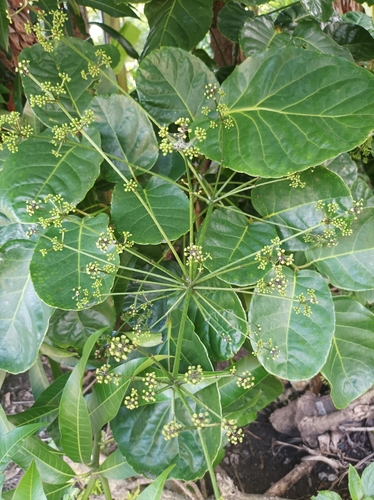
Sources differ, but the reported mature height is about 100–600 cm. The ornamental leaves are described for the species as round and wavy, with broad, tear-resistant leaves that can be used as plate- or bowl-like containers; horticultural material also includes green to green-and-yellow variegated forms. Polyscias is reported to have terminal panicles composed of umbels and to flower rarely outside tropical environments. Polyscias is reported to produce spherical drupes.
Light
Polyscias scutellaria grows in full sun to partial sun; indoors, bright indirect light or partial sun is suitable, while prolonged strong direct light, especially strong afternoon sun, should be avoided.
Watering
It is generally given moderate watering after the surface of the potting medium dries, keeping adequate moisture while avoiding standing water, prolonged excessive wetness, or allowing the medium to become overly dry.
Humidity and airflow
It is generally reported to prefer high humidity.
Temperature and dormancy
A minimum temperature is reported for the plant, but the available claim provides only qualitative precision. Sources differ on the reported hardiness zones, including between genus-level information and species information. It is generally frost tender; keep above freezing.
Growing medium and mounting
A well-drained growing medium is suitable, and the plant can adapt to various well-drained soils; indoor potting media may contain peat and sand, while other recommendations favor acidic to slightly acidic, organic-rich or nutrient-rich soil that remains moist while draining well.
Propagation
Polyscias scutellaria can be propagated from seed or cuttings, and indoor cultivation information for Polyscias specifically mentions stem cuttings.
Common problems
Pests noted for Polyscias include aphids, scale insects, mealybugs, whiteflies, spider mites, and nematodes, with insect damage around the stem base also noted as something to monitor. Prolonged excessive moisture in the growing medium can cause root rot. Insufficient humidity, cold drafts, or cold water may lead to leaf drop; overly dry medium can favor spider-mite problems, excessive moisture can cause root rot, and strong afternoon sun may scorch the leaves. The plant is sensitive to frost and freezing and should also be protected from cold drafts, while strong afternoon sun may scorch its leaves.
Identification
Polyscias scutellaria is a much-branched woody plant with round, ornamental leaves; it can be pruned into a denser form and is also suitable for pots or bonsai.
Photos


Sources
- Wikipedia (en): Polyscias scutellaria — CC BY-SA 4.0 · link
- Wikipedia (fr): Polyscias scutellaria — CC BY-SA 4.0 · link
- GBIF descriptions: Lista de especies de plantas exóticas y trasplantadas de Colombia; Catálogo de Plantas y Líquenes de — per dataset · link
- Useful Tropical/Temperate Plants: Polyscias scutellaria — CC BY-NC-SA 3.0 (facts only) · link
- USDA PLANTS Database: Polyscias scutellaria — Public domain (US Government work) · link
- NC State Plant Toolbox: Polyscias (genus-level) — copyright (facts only) · link
- Top Tropicals catalog: Polyscias scutellaria — © Top Tropicals LLC (facts only) · link