
Water-hyacinth (Pontederia crassipes)
Pontederia crassipes is a free-floating aquatic herb with feathery, hanging roots and can form dense colonies. It is perennial, but in colder temperate environments it may behave as an annual and die during winter.
Overview
Pontederia crassipes is a free-floating aquatic herb with feathery, hanging roots and can form dense colonies. It is perennial, but in colder temperate environments it may behave as an annual and die during winter.
Origin and habitat
It is native to tropical and subtropical South America, including Brazil, the Amazon region, and northern, western, and southern South America, and is now naturalized in many parts of the world. It occurs in aquatic environments such as rivers and pond margins, especially on calm water, and can also grow abundantly in reservoirs and eutrophic lakes. Native to tropical and subtropical South America, it can grow in a variety of warm climates; warm conditions favor growth, while frost damages the leaves.
Characteristics
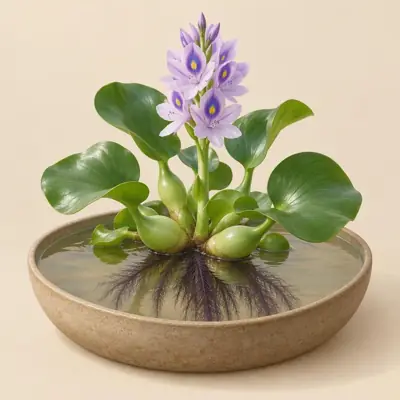
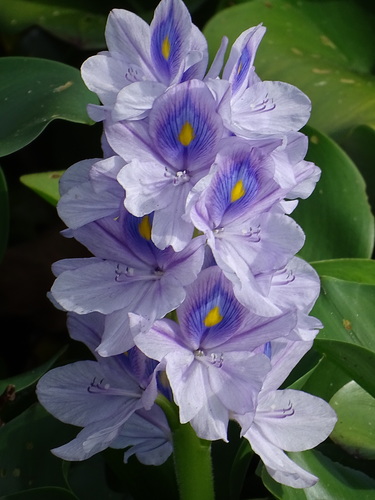
Few sources report a mature height of about 0–100 cm. Growth is extremely rapid, primarily through daughter plants formed on stolons, and colonies can quickly double in area under suitable conditions. The leaves are broad, thick, glossy, and ovate to rounded, with long, spongy petioles that are swollen to varying degrees and help the plant float. Sources differ in their descriptions of the flowers; they are borne in erect spikes and range from purple to pale purplish pink, with a deeply colored upper central perianth lobe bearing a yellow spot, a perianth divided into lobes, and tristylous flowers. A single source reports that flowering occurs from midsummer to mid-autumn in temperate climates and can occur year-round in tropical climates, with individual flowers opening in the morning and withering by evening.
Light
It is generally reported to require abundant sunlight, which supports full flowering.
Watering
As an aquatic plant, it can have roots hanging in the water; horticultural cultivation information also describes growing it in mud at pond margins or placing a container in shallow water.
Temperature and dormancy
Few sources report a lower temperature of about 12 °C, an ideal range of about 25–30 °C, and an upper temperature of about 35 °C.
Propagation
Sources differ in their descriptions of propagation: Pontederia crassipes can reproduce sexually and vegetatively, with seeds dispersed by water and vegetative reproduction occurring mainly through daughter plants formed on stolons, allowing colonies to establish rapidly.
Common problems
A horticultural source generally reports no known major pests or major diseases. It reproduces and spreads extremely rapidly, can form dense floating mats that obstruct waterways and displace native aquatic plants, and the decay of large amounts of plant material can consume dissolved oxygen and cause secondary pollution; sources from Taiwan classify it as an invasive alien plant. It does not tolerate frost, which damages the leaves; very high water temperatures are also not tolerated, while increasing salinity can cause more upright leaf growth, yellowing, and eventual death.
Identification
Pontederia crassipes can be recognized by its free-floating habit, swollen spongy petioles, dark purplish-black feathery hanging roots, and conspicuous purple flower spikes.
Photos


Sources
- Wikipedia (en): Pontederia crassipes — CC BY-SA 4.0 · link
- GBIF descriptions: Database of Vascular Plants of Canada (VASCAN); Checklist of introduced taxa in Romania; Listado de — per dataset · link
- NC State Plant Toolbox: Pontederia crassipes — copyright (facts only) · link
- TaiCOL 臺灣物種名錄: Pontederia crassipes — CC BY 4.0 · link