
Primrose (Primula vulgaris)
Primula vulgaris is a perennial herb that forms a basal rosette and may be evergreen to semi-evergreen.
Overview
Primula vulgaris is a perennial herb that forms a basal rosette and may be evergreen to semi-evergreen.
Origin and habitat
Its native range covers western and southern Europe and extends into North Africa and western Asia, with more detailed accounts including Algeria and areas from Turkey to eastern Iran. It occurs in woodland, hedgerows, grassland or grassy slopes, herbaceous riverbanks, cliffs, and mountains, including woodland and hedgerow habitats on acidic or calcareous soils. It is a temperate plant suited to cooler conditions and summers, and flowers in early spring in the Northern Hemisphere.
Characteristics
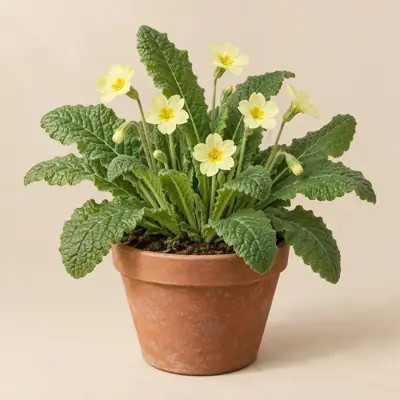
Sources differ on mature height, placing it at about 10–30 cm; a single source reports a mature spread of about 0–10 cm. The leaves form a basal rosette and are conspicuously wrinkled or deeply veined, ranging from tongue-shaped and obovate to oblong, with a gradually narrowed base and irregularly crenate to toothed margins; under suitable conditions they may remain evergreen or semi-evergreen. The flowers are usually pale yellow to primrose yellow, though white and pink forms also occur; individual flowers are borne on stalks arising from the base of the rosette, with flat-spreading corollas, and are usually fragrant, radially symmetrical, bisexual, and heterostylous. Flowering occurs in early spring in the Northern Hemisphere, while the fruit is reported to be an ovoid to more generally capsule-shaped structure that opens by valves at maturity to release seeds.
Light
Primula vulgaris grows in full sun to partial shade; in hotter regions, hot afternoon direct sunlight is best avoided.
Watering
The soil should remain evenly moist while draining well, and a moisture-retentive, humus-rich growing medium is preferred.
Temperature and dormancy
A single source reports cold tolerance to about -25 °C. It is generally classified as RHS H7 for hardiness.
Growing medium and mounting
Primula vulgaris prefers humus-rich, moisture-retentive but well-drained soil and can adapt to loam, clay, sand, and chalk, with acidic, neutral, and alkaline conditions all listed as acceptable by sources.
Common problems
It is reported to be susceptible to slugs, snails, aphids, and red spider mites. A single source reports gray mold, root rot, rust, powdery mildew, leaf spot, and infection by various viruses as possible problems. Hot afternoon sun in warm regions may impair growth, while soil management needs to balance consistent moisture with good drainage. It prefers cool summers and, in hotter regions, should be protected from strong direct afternoon sunlight; it is also highly cold tolerant.
Identification
It is reported to have a very short main stem hidden within the center of the basal rosette, with flower stalks appearing to emerge directly from its base; the typical form has solitary, pale yellow, flat-spreading flowers that can distinguish it from related primroses with different inflorescence forms.
Photos


Sources
- Wikipedia (en): Primula vulgaris — CC BY-SA 4.0 · link
- 維基百科:歐報春 — CC BY-SA 4.0 · link
- Wikipedia (de): Stängellose Schlüsselblume — CC BY-SA 4.0 · link
- Wikipedia (fr): Primula vulgaris — CC BY-SA 4.0 · link
- Wikipedia (es): Primula acaulis — CC BY-SA 4.0 · link
- GBIF descriptions: Checklist of introduced taxa in Cyprus; DAISIE - Inventory of alien invasive species in Europe; Vali — per dataset · link
- NC State Plant Toolbox: Primula vulgaris — copyright (facts only) · link
- Useful Tropical/Temperate Plants: Primula vulgaris — CC BY-NC-SA 3.0 (facts only) · link
- RHS Plants: Primula vulgaris — © RHS, facts only · link