
Cockleshell orchid (Prosthechea cochleata)
Prosthechea cochleata is a perennial, sympodial orchid with pseudobulbs, typically growing as an epiphyte but also occurring on rocks.
Overview
Prosthechea cochleata is a perennial, sympodial orchid with pseudobulbs, typically growing as an epiphyte but also occurring on rocks.
Origin and habitat
Its native range extends from Mexico, Central America, and the Caribbean to southern Florida and northern South America, including Colombia, Venezuela, and Guyana. Sources differ on habitat accounts; it is primarily a forest epiphyte but can also grow on rocks in open areas or scrub, with records from evergreen or deciduous dense forest and oak forest.
Characteristics
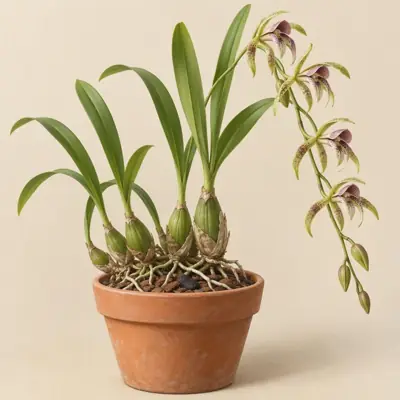
Sources differ on mature height, which is reported at about 40–45 cm; mature spread is reported from few sources at about 10–50 cm. Sources differ in descriptions of the leaves; narrow, elongated to lance-shaped, strap-like, non-succulent leaves arise from the tops of the pseudobulbs. The flowers have pale green petals and a dark purple lip with yellow-green tones, a white base, and dark purple veins; the lip sits above the column to form a hood-like structure, and the flowers are non-resupinate, opening successively so that an individual inflorescence can remain ornamental for an extended period. Sources differ on flowering season: flowering may occur intermittently over an extended period, while another account describes the main flowering period as late spring to early summer.
Light
Provide partial shade to bright filtered light, avoiding strong direct light as the main exposure.
Watering
During active growth, water regularly but moderately in a well-drained medium, allowing the surface to dry slightly before watering again while maintaining adequate humidity; reduce watering and keep drier in winter. It is generally reported to prefer conditions that keep slightly dry.
Humidity and airflow
It is generally reported to prefer high humidity.
Temperature and dormancy
Sources differ in their hardiness classifications. It is generally reported to be frost tender; keep above freezing.
Growing medium and mounting
Use an open, well-drained epiphytic orchid medium; another soil classification lists loam with neutral pH. Prosthechea cochleata is epiphytic.
Feeding
During active growth in spring and summer, orchid fertilizer is reported to be applied periodically with watering.
Propagation
Plants can be propagated by division when they fill their container; another source also records propagation from seed.
Common problems
It is reported to be susceptible to aphids, greenhouse red spider mites, and mealybugs, while generally having no significant disease problems. Excessively dry medium is reported to cause insufficient moisture, and cultivation requires balancing humidity, drainage, and light. It is reported to be sensitive to frost and should be protected from freezing; in cold regions, container-grown plants can be moved indoors for winter.
Identification
The non-resupinate flowers have the lip above the column, forming a hood-like structure that makes the flower appear upside down; the dark, shell-like lip together with the narrow, elongated perianth segments is a conspicuous identifying feature.
Photos


Sources
- Wikipedia (en): Prosthechea cochleata — CC BY-SA 4.0 · link
- Wikipedia (fr): Prosthechea cochleata — CC BY-SA 4.0 · link
- Wikipedia (es): Prosthechea cochleata — CC BY-SA 4.0 · link
- GBIF descriptions: Catálogo de Plantas y Líquenes de Colombia; An Updated Checklist of the Orchidaceae of Honduras — per dataset · link
- Useful Tropical/Temperate Plants: Prosthechea cochleata — CC BY-NC-SA 3.0 (facts only) · link
- RHS Plants: Prosthechea cochleata — © RHS, facts only · link
- USDA PLANTS Database: Prosthechea cochleata — Public domain (US Government work) · link
- Top Tropicals catalog: Prosthechea cochleata — © Top Tropicals LLC (facts only) · link