
peach (Prunus persica)
Prunus persica is a perennial deciduous woody fruit plant that may grow as a small tree or tree-like shrub, with a spreading crown and sometimes multiple trunks.
Overview
Prunus persica is a perennial deciduous woody fruit plant that may grow as a small tree or tree-like shrub, with a spreading crown and sometimes multiple trunks.
Origin and habitat
Sources differ on its native origin: East Asia, particularly China, is given as the principal area of origin, while some accounts extend the native or origin range toward Persia, Iran, or Afghanistan. Its habitat in a truly wild state is reported to be unknown. It is reported to be widely cultivated in warm-temperate and subtropical regions.
Characteristics
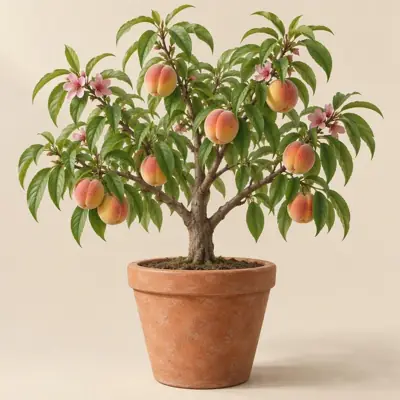
Sources differ on mature height, placing it at about 300–800 cm, while mature spread is 400–800 cm; growth is generally reported to be rapid. The alternate leaves are narrowly elliptic to lanceolate, with pointed to long-tapering tips and serrated margins; they are medium to dark green, and some sources describe the surface as glossy. Flowers are usually solitary or sometimes paired on very short stalks, commonly pink to red but also white; they are typically simple, although some forms may have double flowers, and flowering occurs in spring, usually before or around leaf emergence. The fruit is a usually nearly spherical drupe with juicy flesh that may be white or yellow; typical peach fruit has a fuzzy skin, while fuzzless forms are called nectarines.
Light
Prunus persica grows in full sun and is suited to a sunny, relatively protected position.
Watering
Water regularly, keeping the soil moist but well drained and allowing the surface soil to dry slightly before watering again.
Temperature and dormancy
Sources differ on the minimum temperature, with limited evidence placing it at about -1.1 °C. A source reports an ideal temperature range without a confirmed numerical range here, and generally places the plant within a USDA hardiness-zone range. It is generally reported to tolerate brief light frost.
Growing medium and mounting
Fertile, well-drained soil is preferred; the plant can grow in clay, loam, sand, and chalky soils, with acidic, neutral, or alkaline conditions.
Common problems
Reported common pests include white peach scale, peach gall midge, peach tree borer, lesser peach tree borer, and greater peach tree borer. Common disease problems are reported, although the provided source excerpt does not identify specific diseases. Replanting peach trees in the same ground is reported to result in poor growth, described as a replant problem; the source recommends removing old roots and replacing soil in the planting hole. Because flowering occurs early, flowers may be damaged by late or nighttime frost, making fruit production inconsistent; young plants need more cold protection than mature plants.
Identification
Prunus persica is a deciduous woody plant distinguished by narrow, serrated leaves, pink to red spring flowers, and drupes with a large stone; typical peach fruit has a fuzzy surface.
Photos


Sources
- Wikipedia (en): Peach — CC BY-SA 4.0 · link
- 維基百科:桃 — CC BY-SA 4.0 · link
- Wikipedia (ja): モモ — CC BY-SA 4.0 · link
- Wikipedia (de): Pfirsich — CC BY-SA 4.0 · link
- Wikipedia (es): Prunus persica — CC BY-SA 4.0 · link
- GBIF descriptions: Checklist of introduced taxa in Romania; Especies de arbolado urbano y sus medidas de captura y alma — per dataset · link
- NC State Plant Toolbox: Prunus persica — copyright (facts only) · link
- Wikipedia (it): Prunus persica — CC BY-SA 4.0 · link
- Wikipedia (nl): Perzik — CC BY-SA 4.0 · link
- Wikipedia (pt): Pessegueiro — CC BY-SA 4.0 · link
- TaiCOL 臺灣物種名錄: Prunus persica — CC BY 4.0 · link
- Useful Tropical/Temperate Plants: Prunus persica — CC BY-NC-SA 3.0 (facts only) · link
- RHS Plants: Prunus persica — © RHS, facts only · link
- USDA PLANTS Database: Prunus persica — Public domain (US Government work) · link