
Japanese plum (Prunus salicina)
Prunus salicina is a perennial deciduous woody plant, growing from a small tree to a tree with well-branched, horizontally spreading branches.
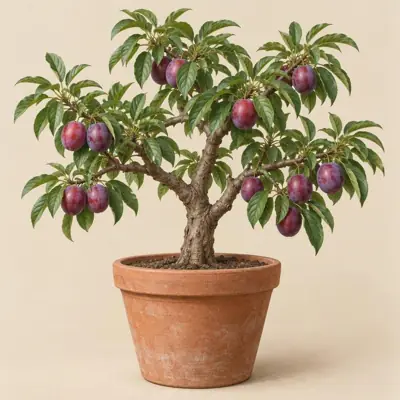
Overview
Prunus salicina is a perennial deciduous woody plant, growing from a small tree to a tree with well-branched, horizontally spreading branches.
Origin and habitat
China is described as its native area, while sources differ on whether its native range also includes Taiwan, northern Vietnam, Korea, the Russian Far East, or Southeast Asia. It can be cultivated as a fruit tree in warm-temperate to subtropical regions and has winter dormancy and a requirement for low temperatures.
Characteristics
Sources differ on mature height, placing it at about 600–1200 cm. The leaves are reported to be simple and alternate, mainly elongated to narrowly elliptic, with a wedge-shaped base, a pointed to shortly tail-pointed tip, serrated or rounded-toothed margins, and a glossy dark-green surface. Sources differ in their descriptions of the white spring flowers, including how they are borne. Flowering is reported to occur in early spring. Sources differ in descriptions of the drupe fruit; the skin may be yellow, red, green, or purple, the flesh may be yellow, yellow-pink, or red, and the fruit matures in summer.
Watering
Rainfall conditions during spring flowering and fruiting are reported to affect disease risk; the source does not provide a general watering frequency for container cultivation.
Common problems
A reported sawfly pest has larvae that bore into young fruit, causing the fruit to stop enlarging and drop. Pocket plum disease has been reported, and Prunus salicina has also been among the plants covered by emergency plant-quarantine control measures for Plum pox virus in Japan. Many cultivars are reported to be self-incompatible, so a single cultivar may not set fruit reliably and may require pollen from another compatible cultivar with overlapping flowering time. Pocket plum disease is reported to become more prevalent when spring temperatures are relatively low and rainfall is greater.
Identification
Prunus salicina is a deciduous fruit tree of the genus Prunus, distinguished by narrow, elongated, almost willow-like leaves, white flowers in early spring, and relatively large drupes forming in summer; the specific epithet salicina refers to the willow-like leaf shape.
Photos


Sources
- Wikipedia (en): Prunus salicina — CC BY-SA 4.0 · link
- 維基百科:中国李 — CC BY-SA 4.0 · link
- Wikipedia (ja): スモモ — CC BY-SA 4.0 · link
- Wikipedia (de): Chinesische Pflaume — CC BY-SA 4.0 · link
- Wikipedia (fr): Prunus salicina — CC BY-SA 4.0 · link
- Wikipedia (es): Prunus salicina — CC BY-SA 4.0 · link
- NC State Plant Toolbox: Prunus salicina — copyright (facts only) · link
- TaiCOL 臺灣物種名錄: Prunus salicina — CC BY 4.0 · link
- Useful Tropical/Temperate Plants: Prunus salicina — CC BY-NC-SA 3.0 (facts only) · link