
Shaving Brush Tree (Pseudobombax ellipticum)
Pseudobombax ellipticum is a perennial deciduous woody plant that grows as a tree with a fleshy, water-storing trunk and a tuber-like swollen base; in cultivation it can be maintained as a smaller tree or shrub-like plant and is also suitable for bonsai.
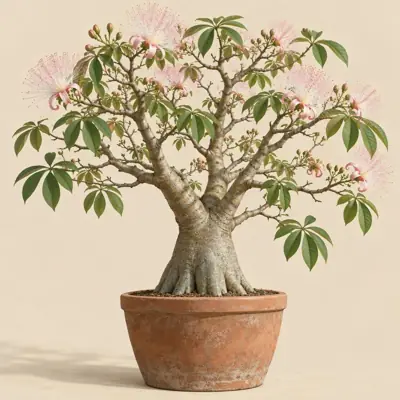
Overview
Pseudobombax ellipticum is a perennial deciduous woody plant that grows as a tree with a fleshy, water-storing trunk and a tuber-like swollen base; in cultivation it can be maintained as a smaller tree or shrub-like plant and is also suitable for bonsai.
Origin and habitat
It is native to southern Mexico and Central America, including Guatemala, El Salvador, Honduras, and Nicaragua; sources differ on whether Cuba and Hispaniola are also part of its native range. It occurs from sea level into higher elevations, mostly at lower elevations, in dry to moist open forests, fields, plains, and rocky slopes, and can also grow in dry, rocky, or poor soils. It occurs in tropical to subtropical climates and can withstand brief mild cold, but overall it is a frost-sensitive tropical plant.
Characteristics
Mature height is 600–2000 cm, and the few available sources report a mature spread of about 250–400 cm. It grows quickly and has a swollen stem; its long-stalked, palmately compound leaves have several leaflets, with new foliage ranging from dark chestnut-red to copper-red before becoming green, although sources differ in their descriptions of the leaves. The large, fragrant flowers range through pink, white, and purple tones and bear many long, conspicuous stamens that create a shaving-brush or powder-puff appearance; flowers generally appear before the leaves and individual flowers are short-lived. Sources differ on the flowering season, while the fruit is a slender, yellow-brown capsule that splits open when mature and contains many seeds with cotton-like fibers that can be dispersed by wind; plants can become large in nature but are commonly kept smaller in cultivation and can be maintained compact by pruning in containers.
Light
Full sun is preferred, though some sources allow full sun to partial sun; indoors, bright light is needed.
Watering
Sources differ in their watering descriptions, but regular watering during active growth is indicated along with good drainage and avoidance of standing water; while in leaf, keep evenly moist. During leafless dormancy, reduce watering, avoid excessive wetness, and water sparingly while leafless.
Temperature and dormancy
Sources are few and differ on cold limits, with about -7 °C reported as a minimum. A single source reports a USDA hardiness range, and the plant is generally reported to tolerate brief light frost. It drops its leaves and goes dormant; a specialist source reports that dormancy is triggered by cold. A specialist source reports that it has low heat tolerance.
Growing medium and mounting
It grows in well-drained loam or sandy soil across acidic to alkaline conditions, while another source mentions a humus-rich, well-drained medium. A single source reports that it needs a fast-draining mix.
Propagation
Pseudobombax ellipticum can be propagated by seed or by semi-hardwood or hardwood cuttings; seeds are reported to germinate within a relatively short period.
Common problems
It is generally reported to have few pest and disease problems. A specialist source reports that overwatering can cause rot, complete drying can lead to plant death, and container-grown plants may be sensitive to intense sun during hot summers. It is a relatively frost-sensitive tropical plant; mature plants can briefly withstand light frost or temperatures near freezing, while young plants require better protection from low temperatures.
Identification
Pseudobombax ellipticum has a smooth gray-green to green, swollen, water-storing trunk whose base can develop a tortoise-shell-like tuberous appearance, and its large flowers have many radiating, slender stamens that resemble a shaving brush.
Photos


Sources
- Wikipedia (en): Pseudobombax ellipticum — CC BY-SA 4.0 · link
- 維基百科:修面刷树 — CC BY-SA 4.0 · link
- LLIFLE Encyclopedia of living forms: Pseudobombax ellipticum — CC BY-SA · link
- Useful Tropical/Temperate Plants: Pseudobombax ellipticum — CC BY-NC-SA 3.0 (facts only) · link
- RHS Plants: Pseudobombax ellipticum — © RHS, facts only · link
- Top Tropicals catalog: Pseudobombax ellipticum — © Top Tropicals LLC (facts only) · link
- PUKUBOOK: Pseudobombax ellipticum — CC BY-NC (facts only) · link
- Pseudobombax ellipticum Care Sheet (sprouthome.com) — facts only (§12) · link
- Pseudobombax Ellipticum: The Show-Stopping Caudex Tree (thursd.com) — facts only (§12) · link