
Cattley Guava (Psidium cattleyanum)
Psidium cattleianum is an evergreen, much-branched shrub to small tree. It is generally reported to be perennial.
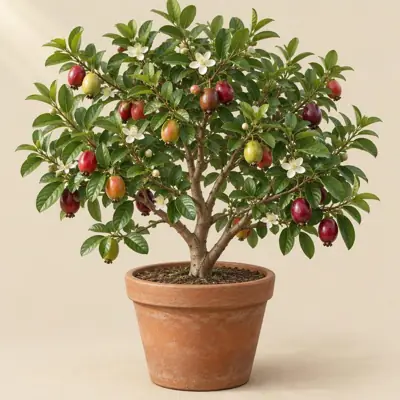
Overview
Psidium cattleianum is an evergreen, much-branched shrub to small tree. It is generally reported to be perennial.
Origin and habitat
Sources differ on its native range: it is native to South America and is mainly recorded from Brazil, while some accounts extend the native range to Uruguay and southern South America. It occurs in tropical rainforest, Atlantic rainforest, evergreen Araucaria forest, and coastal forest, favoring more open sites with moist soil; in introduced areas it can also enter disturbed and undisturbed habitats. It is adapted to humid tropical to subtropical climates, can grow across a range of elevations, and is reported to tolerate varied environmental conditions.
Characteristics
Sources differ, with a reported mature height of about 100–1200 cm. The leaves are elliptical to elliptic in shape. Sources differ in describing the flowers: they may be solitary, while other accounts describe small clusters; the flowers are borne on new shoots. It is reported to flower and fruit repeatedly through the year; the fruit has thin skin and can mature from yellow to dark red or purple, with a sweet, aromatic flavor.
Light
It grows in full sun to bright, light shade and also has relatively strong shade tolerance.
Watering
It is reported to prefer moist conditions and moist, well-drained soil, while tolerating some swampy or waterlogged conditions.
Temperature and dormancy
Few-source reporting places the lower temperature at about -6 °C, the ideal range at about 22–28 °C, and the upper temperature at about 32 °C. Its hardiness is generally reported within a USDA zone range.
Growing medium and mounting
It prefers well-drained sandy loam containing leaf humus, can adapt to varied soil conditions, and favors a mildly acidic soil reaction while tolerating a broader range.
Propagation
It can be propagated from seed, semi-ripe cuttings, and layering, and can also naturally form root suckers. Fresh seed can be sown in a partially shaded seedbed and is reported to germinate after a period of time.
Common problems
It is reported to provide habitat or a host environment for fruit flies, potentially increasing agricultural harm. In suitable tropical and subtropical environments it can form dense thickets, shade other plants, and spread rapidly through seeds, birds, feral pigs, and root suckers, creating a substantial invasive risk. Tender new shoots are reported to be vulnerable to severe cold damage, while dormant plants can tolerate colder conditions briefly; suitable daytime temperatures are considerably higher.
Identification
Compared with other Psidium species, Psidium cattleianum can be distinguished by lanceolate bracts, solitary flowers, and a calyx that is closed in bud and splits irregularly when the flower opens; it can also produce root suckers and develop dense thickets.
Sources
- Wikipedia (en): Psidium cattleianum — CC BY-SA 4.0 · link
- GBIF descriptions: Arbolado urbano de Bogotá D.C asociado a servicios ambientales y culturales valorados como base de l — per dataset · link
- Useful Tropical/Temperate Plants: Psidium cattleianum — CC BY-NC-SA 3.0 (facts only) · link
- USDA PLANTS Database: Psidium cattleianum — Public domain (US Government work) · link