
Butterfly orchid (Psychopsis papilio)
Psychopsis papilio is described as an evergreen perennial epiphytic herbaceous orchid with pseudobulbs, although sources differ in their descriptions. It is also reported to be an evergreen perennial herb.
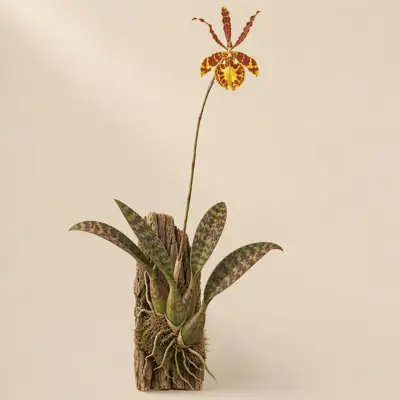
Overview
Psychopsis papilio is described as an evergreen perennial epiphytic herbaceous orchid with pseudobulbs, although sources differ in their descriptions. It is also reported to be an evergreen perennial herb.
Origin and habitat
It is native to tropical America, with core records from Panama, Trinidad and Tobago, Colombia, Venezuela, Suriname, French Guiana, and northern Brazil; sources differ, with some also recording Ecuador and Peru. It occurs mainly as an epiphytic orchid in warm, humid forests, and specialist orchid sources describe it as a plant of low-mountain forests. Its habitat has a warm to hot, humid tropical-forest climate.
Characteristics
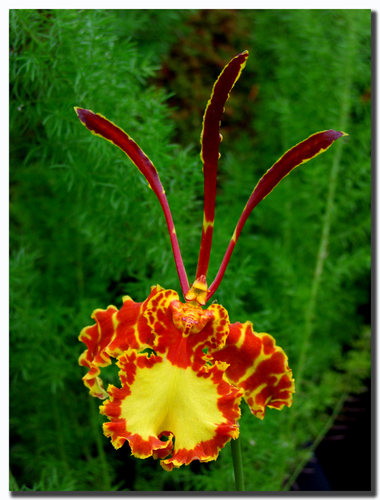
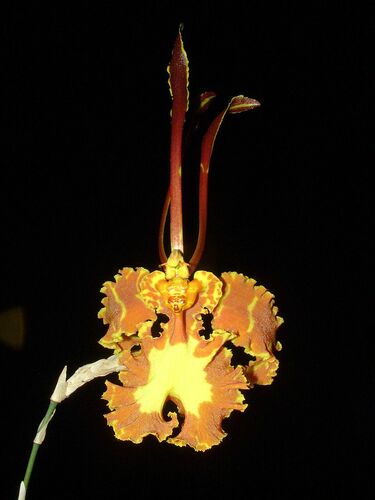
A single source reports a mature height of about 60.96–152.4 cm, so sources are few. The leaves are oblong to oblong-elliptic, relatively thick, stiff or leathery, dark green to brownish green, and often marked with purplish red or reddish brown; sources differ in their descriptions, though they more consistently describe a single leaf at the top of a mature pseudobulb. The large, butterfly-like flowers are yellow to golden yellow with reddish-brown or purplish-red markings; the dorsal sepal and lateral petals are slender and extend upward, while the lateral sepals and lip are broader, and the lip is lobed with a wavy or ruffled edge. The flower spike can open flowers successively over a long period, and sources differ in describing flowering as possible across the seasons.
Light
It grows mainly in bright, shaded to partly shaded conditions; higher light is associated with high humidity and good airflow. It is suited to medium light.
Watering
Water regularly and relatively frequently during active growth, allowing the growing medium to dry slightly between waterings; reduce water in cooler conditions or winter and avoid prolonged wetness. A specialist source reports watering at about every 2–3 days in summer, so sources are few. A specialist source generally recommends letting it dry between waterings.
Humidity and airflow
It prefers high humidity; a specialist source reports about 75–80 %, so sources are few. A specialist source generally reports that it needs good airflow.
Temperature and dormancy
Sources differ on its reported hardiness-zone classification. It is reported to be frost tender; keep above freezing. It is warm-growing.
Growing medium and mounting
It needs a well-drained growing medium; as an epiphytic orchid, it can also be attached to a tree trunk or a similar epiphytic support, with roots receiving both moisture and airflow. It is epiphytic and can be grown mounted.
Feeding
It is reported to benefit from regular feeding during the growing season.
Common problems
Excessive moisture around new growth in winter may lead to fungal rot, while overwatering may cause root rot. A principal cultivation risk is a growing medium that remains wet for too long; although ample water is needed during active growth, the medium should dry slightly between waterings, with less water during the cold season. It is reported to be sensitive to frost and freezing, and in cold regions it needs a protected environment in winter.
Identification
Flattened, nearly round pseudobulbs with red markings and a slender basal flower spike that opens flowers successively are identifying features. The flowers are distinguished especially by slender dorsal sepals and lateral petals that extend upward like butterfly antennae.
Photos


Sources
- GBIF Backbone: Psychopsis papilio (Lindl.) H.G.Jones — CC BY 4.0 · link
- Wikipedia (en): Psychopsis papilio — CC BY-SA 4.0 · link
- Wikipedia (ja): サイコプシス・パピリオ — CC BY-SA 4.0 · link
- Wikipedia (fr): Psychopsis papilio — CC BY-SA 4.0 · link
- Wikipedia (es): Psychopsis papilio — CC BY-SA 4.0 · link
- Wikipedia (pt): Oncidium papilio — CC BY-SA 4.0 · link
- Internet Orchid Species Photo Encyclopedia: Psychopsis papilio — © Jay Pfahl / IOSPE contributors, facts only · link
- Baker Orchid Species Culture (free sampler): Psychopsis papilio — © Charles O. Baker and Margaret L. Baker (1998), facts only · link
- Top Tropicals catalog: Psychopsis papilio — © Top Tropicals LLC (facts only) · link