
slender brake (Pteris ensiformis)
Pteris ensiformis is a perennial terrestrial fern that commonly grows in clumps and can be cultivated as a foliage plant.
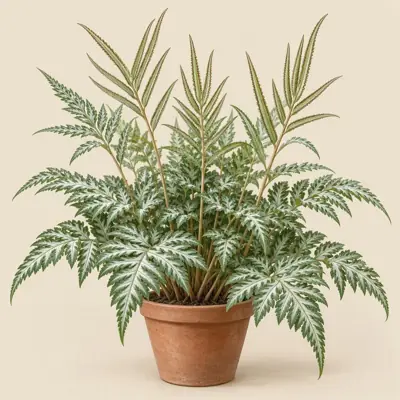
Overview
Pteris ensiformis is a perennial terrestrial fern that commonly grows in clumps and can be cultivated as a foliage plant.
Origin and habitat
Sources differ on details of its native range, which extends broadly from Asia into the Pacific and Oceania, including China, Japan, India, Sri Lanka, Southeast Asia, the Malay Archipelago, New Guinea, and Australia; it also occurs naturally in Taiwan and is listed there as native. Sources describe its habitats differently, including forest floors, understory, forest-edge slopes, and stream margins, as well as moist acidic soils in southern China and sunnier, somewhat drier open woodland floors and roadside stone walls in Japan. Its reported distribution and cultivation information mainly cover tropical and subtropical climates.
Characteristics
Sources differ, with the few sources indicating a mature height of about 30–50 cm. Sources differ in their descriptions of the leaves: they are clustered and distinctly dimorphic, with broader vegetative fronds and narrower, upright spore-bearing fronds; the slender petioles are straw-colored, the leaves are usually twice pinnate with paired lateral pinnae and a conspicuous terminal pinna, and the veins are free. Variegated cultivars can have white or silvery-white markings along the main veins. Pteris ensiformis has a creeping rhizome.
Light
Bright indirect light to partial shade is suitable, while strong direct sunlight should be avoided; the wild type can also adapt to deeper shade.
Watering
Keep the growing medium evenly moist during active growth and avoid prolonged drying; in winter, allow the potting medium to become somewhat drier before watering, while maintaining good drainage.
Humidity and airflow
Pteris ensiformis is generally reported to prefer high humidity and need good airflow, with a high humidity need.
Temperature and dormancy
Pteris ensiformis is generally reported for a USDA hardiness-zone range, but the available claim does not provide a numerical range that can be stated here. It is tender and frost tender; keep above freezing.
Growing medium and mounting
Use an organic-rich, well-drained growing medium; the wild type is also recorded growing in moist acidic soil.
Feeding
During the growing period from spring through autumn, slow-release chemical fertilizer or fast-acting liquid fertilizer is reported to be suitable at regular intervals.
Propagation
Pteris ensiformis can be propagated by spores or division, and spores are dispersed by wind. It is reported that basal offsets can be separated during repotting for division, avoiding severe root damage and potting them according to plant size.
Common problems
Cultivated Pteris are reported to be susceptible to spider mites, scale insects, and leaf-roller moths. Cultivated Pteris are also reported to develop anthracnose, with brown circular spots appearing on the leaves. Strong direct sunlight and high temperatures may cause leaves to dry or yellow, and the growing medium should not remain completely dry for prolonged periods. It is sensitive to frost and low temperatures; in cold regions, container growing and moving plants indoors during cold periods can help avoid freezing conditions.
Identification
Sources differ in their descriptions, but vegetative and spore-bearing fronds are distinct in form: the vegetative fronds have broader, potentially divided lateral pinnae, while the spore-bearing fronds are narrower and longer, with an especially conspicuous terminal pinna. The sori extend along the margins of the pinnae or pinnules and have long, linear marginal false indusia.
Photos


Sources
- Wikipedia (en): Pteris ensiformis — CC BY-SA 4.0 · link
- 維基百科:剑叶凤尾蕨 — CC BY-SA 4.0 · link
- Wikipedia (ja): ホコシダ — CC BY-SA 4.0 · link
- Wikipedia (fr): Ptéris à feuilles fines — CC BY-SA 4.0 · link
- Wikipedia (es): Pteris ensiformis — CC BY-SA 4.0 · link
- TaiCOL 臺灣物種名錄: Pteris ensiformis — CC BY 4.0 · link
- Useful Tropical/Temperate Plants: Pteris ensiformis — CC BY-NC-SA 3.0 (facts only) · link
- USDA PLANTS Database: Pteris ensiformis — Public domain (US Government work) · link
- 臺北典藏植物園 植物資料庫: Pteris ensiformis — © 臺北典藏植物園, facts only · link
- NHK みんなの趣味の園芸 植物図鑑: Pteris ensiformis — © NHK出版, facts only · link
- NC State Plant Toolbox: Pteris (genus-level) — copyright (facts only) · link
- Top Tropicals catalog: Pteris ensiformis — © Top Tropicals LLC (facts only) · link