
ladder brake (Pteris vittata)
Pteris vittata is an evergreen perennial herbaceous fern with clustered fronds. It is reported to be perennial.
Overview
Pteris vittata is an evergreen perennial herbaceous fern with clustered fronds. It is reported to be perennial.
Origin and habitat
Sources differ on its native range, which is described as extending broadly across warm parts of the Old World, including Africa, southern and other parts of Europe, Asia including China, Japan, Taiwan and tropical Asia, and Australia; TaiCOL treats the Taiwan populations as native, while several parts of North America have clear records of introduction. Sources differ in their habitat descriptions: it can occur in warm low-elevation areas, broadleaf forests, open slopes, roadsides, ditches, stone and brick walls, limestone-associated environments, urban buildings and cracks in concrete, while some Japanese sources particularly describe drier, sunny stone-wall habitats. It is reported to occur mainly across tropical, subtropical and other warmer regions, while also being native to parts of southern Europe and temperate Asia.
Characteristics
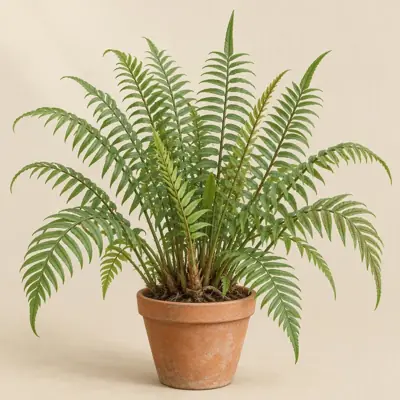
Sources differ in their descriptions of frond size, but describe once-pinnate fronds with a conspicuous, relatively long terminal pinna; the numerous lateral pinnae are nearly linear to narrowly lanceolate, become progressively shorter near the base, and can have finely serrate or finely crenate margins, while pale brown scales may occur at the stipe base and on the rachis. Few sources report a mature height of about 75–180 cm. It is reported to have an erect rhizome.
Light
It is reported to grow in sunny environments, while it has also been recorded in warm, humid broadleaf forests.
Growing medium and mounting
It is reported to be associated with limestone environments and can also grow on substrates such as stone walls, brick walls and cracks in concrete.
Propagation
The sori are reported to be long and linear, arranged along both margins of the pinnae and protected by false indusia formed by the rolled frond margins.
Common problems
It is reported to absorb and accumulate arsenic from soil in large amounts, so plants growing in arsenic-contaminated environments may contain high concentrations of arsenic.
Identification
The rhizome is reported to bear pale brown scales, and the fronds are once-pinnate with a particularly conspicuous terminal pinna. The sori are reported to be long and linear along the margins of fertile pinnae, with the rolled frond margins forming a protective structure.
Photos


Sources
- Wikipedia (en): Pteris vittata — CC BY-SA 4.0 · link
- 維基百科:鱗蓋鳳尾蕨 — CC BY-SA 4.0 · link
- Wikipedia (ja): モエジマシダ — CC BY-SA 4.0 · link
- Wikipedia (de): Gebänderter Saumfarn — CC BY-SA 4.0 · link
- Wikipedia (es): Pteris vittata — CC BY-SA 4.0 · link
- GBIF descriptions: Manual of the Alien Plants of Belgium; Lista de especies de plantas exóticas y trasplantadas de Colo — per dataset · link
- TaiCOL 臺灣物種名錄: Pteris vittata — CC BY 4.0 · link
- USDA PLANTS Database: Pteris vittata — Public domain (US Government work) · link