
pomegranate (Punica granatum)
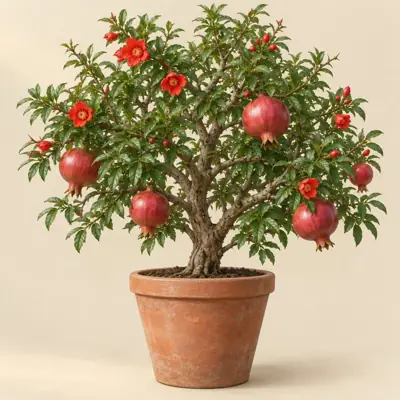
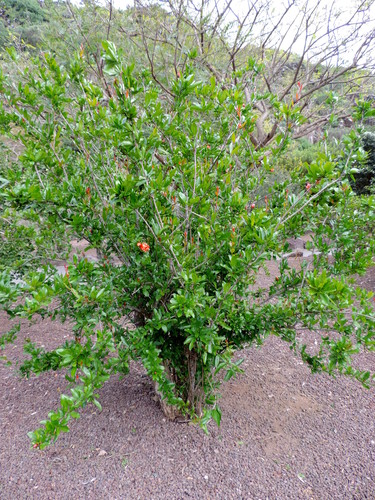
Punica granatum is a perennial deciduous woody shrub to small tree that may grow as a many-branched shrub, with some branches bearing spines.
Overview
Punica granatum is a perennial deciduous woody shrub to small tree that may grow as a many-branched shrub, with some branches bearing spines.
Origin and habitat
Sources differ on its native range, which is centered in western to central Asia around Iran and surrounding areas and extends toward the Caucasus, Turkmenistan, Afghanistan, and northwestern India. It occurs in dry hills and dry limestone-soil habitats and favors well-drained, sunny conditions. It is suited to warm-temperate to subtropical climates and favors warm, relatively dry, sunny conditions; drier climates favor fruit quality.
Characteristics
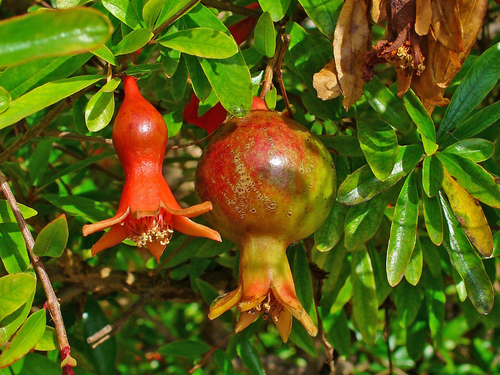
Sources differ on mature height, placing it at about 150–700 cm, while a single source reports a mature spread of about 244–305 cm. Growth is slow, and the usually deciduous leaves are simple and entire, mostly opposite or nearly opposite but sometimes nearly clustered, ranging from elliptic and oblong to obovate and sometimes glossy. Flowers are usually bright red to orange-red or scarlet and commonly borne at branch tips or leaf axils, with a thick persistent calyx, usually red petals, and numerous stamens; some cultivated forms have other flower colors, and flowering occurs from late spring through summer. The fruit is nearly spherical, with a thick skin that may be yellow, red, or reddish brown and a persistent calyx at the tip, and contains many seeds with juicy, fleshy outer seed coverings.
Light
Full sun is best, though partial shade is tolerated; container or greenhouse plants should receive ample light.
Watering
Provide more water during active growth while keeping the growing medium well drained, reduce watering in winter, and for container plants allow the surface to dry before watering again; the plant has some drought tolerance.
Humidity and airflow
It is reported to prefer low humidity.
Temperature and dormancy
Sources differ on the lower temperature figure, with limited evidence placing it at about -10 °C. A single source reports an ideal range of about 23–32 °C and a maximum of about 40 °C, so sources are few for these figures. Sources differ on its hardiness-zone classification, while cross-source evidence describes Punica granatum as frost hardy.
Growing medium and mounting
Sources differ in their soil descriptions, but indicate that Punica granatum adapts to various soils, with fertile, well-drained soil preferred, and can grow in sandy or heavier clay-rich soils.
Feeding
A single source reports that balanced liquid fertilizer may be applied during the growing period.
Propagation
Punica granatum can be propagated by seed, cuttings, or layering; semi-woody shoots can be used for summer cuttings, while another source reports that thicker branch cuttings taken in early spring also root readily.
Common problems
Overall pest and disease problems are relatively limited, though scale insects may occur; scale infestations may be accompanied by sooty mold, and there is also a rare risk of Armillaria disease. Fruit production may be poor in humid tropical conditions, and fruit ripening favors a warm autumn; in cold regions, plants may need protection or container plants may be moved indoors for winter. Young shoots can be severely damaged around freezing conditions; dormant plants are more cold tolerant, but severe cold may still damage above-ground growth.
Identification
A single source reports that young branches are often four-angled and may end in spines; distinguishing features also include bright red flowers, a thick persistent calyx, and spherical fruit containing many juicy seeds.
Photos


Sources
- Wikipedia (en): Pomegranate — CC BY-SA 4.0 · link
- 維基百科:石榴 — CC BY-SA 4.0 · link
- Wikipedia (ja): ザクロ — CC BY-SA 4.0 · link
- Wikipedia (de): Granatapfel — CC BY-SA 4.0 · link
- Wikipedia (fr): Grenadier commun — CC BY-SA 4.0 · link
- Wikipedia (es): Punica granatum — CC BY-SA 4.0 · link
- GBIF descriptions: Checklist of introduced taxa in Cyprus; Arbolado urbano de Bogotá D.C asociado a servicios ambiental — per dataset · link
- NC State Plant Toolbox: Punica granatum — copyright (facts only) · link
- Wikipedia (nl): Granaatappel — CC BY-SA 4.0 · link
- TaiCOL 臺灣物種名錄: Punica granatum — CC BY 4.0 · link
- Useful Tropical/Temperate Plants: Punica granatum — CC BY-NC-SA 3.0 (facts only) · link
- RHS Plants: Punica granatum — © RHS, facts only · link
- USDA PLANTS Database: Punica granatum — Public domain (US Government work) · link
- Top Tropicals catalog: Punica granatum — © Top Tropicals LLC (facts only) · link