
cultivated radish (Raphanus sativus)
Raphanus sativus is an upright herb with an enlarged taproot or a swollen structure formed by the hypocotyl and root. Sources differ on whether it is annual or biennial.
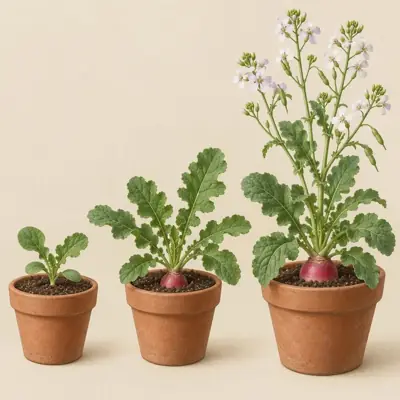
Overview
Raphanus sativus is an upright herb with an enlarged taproot or a swollen structure formed by the hypocotyl and root. Sources differ on whether it is annual or biennial.
Origin and habitat
Sources differ on its origin, with records variously placing it in Europe, southeastern Europe, the Mediterranean, or Eurasia, while other accounts regard its cultivated origin as uncertain and its wild form as unknown. It is mainly cultivated and is recorded in farmland, vegetable gardens, parks and gardens, as well as coastal sands, shores of inland waters, woodland edges, and human-made environments; its wild habitat is uncertain. It is reported to be cultivable from temperate to tropical climates, with only certain tropical environments described as more suitable.
Characteristics
Sources differ, placing mature height at about 20–100 cm; mature spread is reported from few sources at about 10–50 cm. It grows rapidly, and basal leaves may form a rosette, commonly with lyrately pinnatifid to deeply pinnatifid forms, a larger terminal lobe, and coarse hairs on some leaves. The flowers have a cross-shaped arrangement of petals and may be white, pale purple, purple, pinkish white, or pale yellow to creamy white; some sources describe darker veins on the petals, and flowering is generally reported from spring to early summer. The fruit is an indehiscent silique that may be cylindrical with longitudinal ribs or have multiple constrictions and contains multiple seeds.
Light
Full sun is best, though partial shade is tolerated; shade lengthens the time required for the swollen root to reach harvest size.
Watering
The soil should retain ample moisture while draining well; irrigation is needed during dry periods, as insufficient water can rapidly reduce root quality and promote bolting.
Temperature and dormancy
From the limited source information, the ideal temperature is reported to be about 12–25 °C, with a minimum of about 3 °C and a maximum of about 30 °C.
Growing medium and mounting
It prefers fertile, light, moisture-retentive but well-drained soil; loam or sandy soil favors smooth, tender roots, while chalky or clay soils can also be used. Very heavy or overly acidic soil is unfavorable.
Propagation
It is generally propagated by seed.
Common problems
Slugs, snails, and flea beetles are reported as possible pests. Downy mildew of crucifers may occur, and damping-off has also been recorded in seedlings. Very heavy or overly acidic soil can hinder growth, while shade delays swollen roots from reaching harvest size. It is reported to be sensitive to drought, with insufficient water during dry periods rapidly reducing root quality and promoting bolting.
Identification
A principal distinguishing feature is the rapid formation of an enlarged taproot or swollen root-hypocotyl structure, ranging in shape from spherical to slender and cylindrical, with skin that may be white, pink, red, purple, yellow, green, or black.
Photos


Sources
- Wikipedia (en): Radish — CC BY-SA 4.0 · link
- Wikipedia (ja): ダイコン — CC BY-SA 4.0 · link
- Wikipedia (de): Garten-Rettich — CC BY-SA 4.0 · link
- Wikipedia (fr): Radis — CC BY-SA 4.0 · link
- Wikipedia (es): Raphanus sativus — CC BY-SA 4.0 · link
- GBIF descriptions: Manual of the Alien Plants of Belgium; The checklist of alien seed plants of D.R. Congo, based on ev — per dataset · link
- NC State Plant Toolbox: Raphanus sativus — copyright (facts only) · link
- Useful Tropical/Temperate Plants: Raphanus sativus — CC BY-NC-SA 3.0 (facts only) · link
- RHS Plants: Raphanus sativus — © RHS, facts only · link
- USDA PLANTS Database: Raphanus sativus — Public domain (US Government work) · link