
Creeping raphio (Raphionacme procumbens)
Raphionacme procumbens is a perennial herb with an underground caudex and hairy, herbaceous stems that may branch from the base; horticultural sources also describe its growth as climbing or prostrate. It is reported to be perennial.
Overview
Raphionacme procumbens is a perennial herb with an underground caudex and hairy, herbaceous stems that may branch from the base; horticultural sources also describe its growth as climbing or prostrate. It is reported to be perennial.
Origin and habitat
It is native to southern Africa, with sources listing Mozambique, Zimbabwe, Eswatini, and South Africa, including KwaZulu-Natal, Limpopo, and Mpumalanga in South Africa. It is reported from grassland and open woodland habitats.
Characteristics
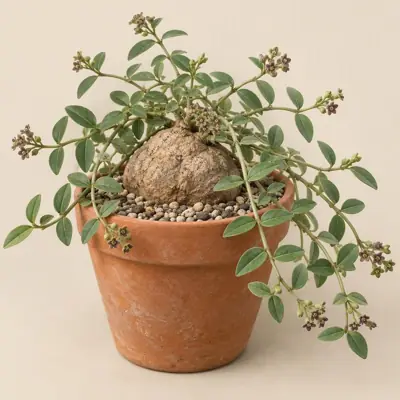
Its mature spread is 15–40 cm. Sources differ in describing the simple leaves as narrowly elliptic, oblong-lanceolate, elliptic-lanceolate, or ovate; they are softly hairy to velvety, with entire margins, dark green upper surfaces, and pale green undersides. The small, star-shaped flowers have green to yellow-green corollas that may be maroon or violet at the base, with a fleshy, three-lobed red to purple corona; the inflorescences are nearly spherical and many-flowered. It is reported to flower in summer and usually to produce a single, pendent, ovate follicle with a pointed tip; it has a swollen root, and its tuberous root and stems can become relatively large and long.
Light
A bright setting is recommended, but sources differ between partial sun and full sun or strong indoor light.
Watering
During active growth, provide moderate to more generous moisture and water after the surface has dried; during dormancy, do not continue regular watering and keep it relatively dry in winter. It is generally recommended that while in leaf, water when the mix has dried, and withhold water while leafless.
Temperature and dormancy
Few sources report a minimum of about 5 °C. Sources differ on its hardiness classification. It is frost tender; keep above freezing.
Growing medium and mounting
It is generally reported to require a nutrient-rich but very well-drained growing medium and needs a very fast-draining mix.
Propagation
It is generally propagated by seed.
Common problems
Poor cultivation management is reported to cause unsightly holes in the tuberous root, while improper watering or management of root exposure may lead to root rot or scorching of the tuberous root. It is frost sensitive and should be kept away from freezing conditions; sources also recommend keeping it above a stated minimum temperature.
Identification
Raphionacme procumbens has a nearly spherical, swollen underground tuberous root that produces hairy, prostrate herbaceous stems and small, star-shaped flowers in green to purplish-green tones.