
Majestic palm (Ravenea rivularis)
Ravenea rivularis is a tropical evergreen perennial palm that develops an upright, solitary habit and a large, tree-like appearance at maturity. It is generally reported to be a perennial evergreen.
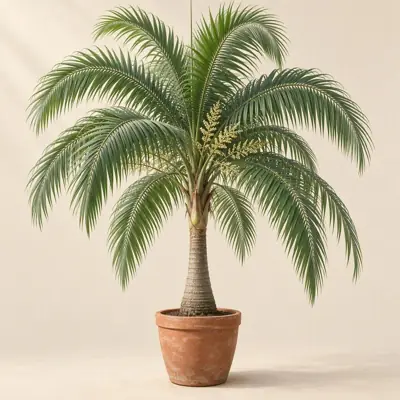
Overview
Ravenea rivularis is a tropical evergreen perennial palm that develops an upright, solitary habit and a large, tree-like appearance at maturity. It is generally reported to be a perennial evergreen.
Origin and habitat
Ravenea rivularis is native to Madagascar. It occurs in relatively isolated, moist habitats, commonly along rivers, streams, and natural lagoon margins and also in shallow swamps, where water and humidity remain abundant throughout the year. Although the surrounding native climate is generally hot, dry, and semi-arid, the palm is concentrated in warm, highly humid tropical microhabitats near water.
Characteristics
Mature height is 3000–3048 cm. Sources differ on growth rate: growth is described as fast in its native habitat but markedly slower indoors. The green leaves are long, upward-arching, and pinnately divided, with narrow, elongated leaflets. The small yellowish-white flowers are reported to appear only on mature plants and are usually hidden among the foliage; the fleshy fruits are nearly spherical to slightly oval, changing from green to orange-red or bright red as they mature.
Light
Sources differ on light conditions, but describe a preference for bright light, with bright indirect light indoors and avoidance of strong direct sunlight that can scorch the leaves.
Watering
Keep the growing medium consistently moist with regular watering; water demand is higher in spring and summer, and the medium should not dry out completely, while good drainage and avoidance of overwatering are important because overwatering can cause root rot.
Humidity and airflow
Ravenea rivularis is generally reported to prefer high humidity.
Temperature and dormancy
The limited source reports a minimum temperature of about -1.1 °C. Sources differ on the hardiness-zone classification. It is generally described as frost tender; keep above freezing.
Growing medium and mounting
Ravenea rivularis prefers moist loam or clay; in containers, use a well-drained medium and container, while some sources also suggest a fast-draining cactus-type medium or soil-based compost.
Feeding
Container-grown plants can receive a palm fertilizer; slow-release fertilizer containing nitrogen, phosphorus, potassium, and magnesium is described as an ideal option, while small amounts of Epsom salt may supply magnesium and liquid fertilizer can also be used during the warm season.
Propagation
Ravenea rivularis is generally reported to be propagated by germinating seed, with germination taking a period of months.
Common problems
It is reported to be susceptible to spider mites, aphids, whiteflies, mealybugs, scale insects, and thrips, with low humidity potentially increasing pest problems. Overwatering is reported to cause root rot, and the source does not identify other serious diseases. Brown leaf tips are common indoors, while yellow leaves may be associated with insufficient light, insufficient water, overwatering, low humidity, or inadequate nutrients. The plant is sensitive to frost and should be protected from freezing; indoors, it should also be kept away from cold drafts and direct heat sources.
Identification
Ravenea rivularis is a large, single-trunked palm with a broad crown and long, slightly arching pinnate leaves; its trunk is cylindrical or slightly swollen around the middle, with a broader base.
Photos


Sources
- Wikipedia (en): Ravenea rivularis — CC BY-SA 4.0 · link
- 維基百科:國王椰子 — CC BY-SA 4.0 · link
- Wikipedia (fr): Ravenea rivularis — CC BY-SA 4.0 · link
- Wikipedia (es): Ravenea rivularis — CC BY-SA 4.0 · link
- NC State Plant Toolbox: Ravenea rivularis — copyright (facts only) · link
- Top Tropicals catalog: Ravenea rivularis — © Top Tropicals LLC (facts only) · link