
Rhaphidophora decursiva (Rhaphidophora decursiva)
Rhaphidophora decursiva is a large climbing vine that can creep along the ground or rocks or climb trees.
Overview
Rhaphidophora decursiva is a large climbing vine that can creep along the ground or rocks or climb trees.
Origin and habitat
Rhaphidophora decursiva is native to Asia, including Nepal, northeastern India and other parts of the Indian subcontinent, Bangladesh, Thailand, Laos, Vietnam, southwestern China and other parts of southern China; the Taiwan species list also treats it as native to Taiwan, while other sources additionally record Myanmar, Sri Lanka, Sikkim and Java, and sources differ in their accounts of its range. It occurs in monsoon rain forest, valley evergreen broadleaf forest, and mixed broadleaf forest from upper hills to low mountains in subtropical to warm-temperate environments; it can creep on the ground or rocks or climb trees, and sources differ on its elevational range. Its native habitat is reported to include monsoon rain forest and subtropical to warm-temperate hill and low-mountain forest environments.
Characteristics
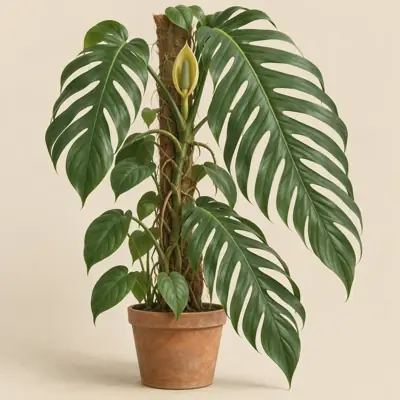
Sources differ, but the limited source basis suggests a mature height of about 2000–2000 cm. It is reported to grow rapidly and vigorously. Young leaves are nearly round with entire margins, while mature leaves are large and oblong-ovate to ovate, deeply divided to the midrib with multiple lobes on each side, pale green beneath and green above. The inflorescence is reported to be axillary and usually solitary, with a yellow, boat-shaped to elongate-ovate spathe and a sessile, gray-green, cylindrical spadix; the infructescence bears greenish-white berries with a white or yellow base, and at maturity the persistent stylar region falls away to expose a white or yellow pulp cavity.
Light
It is reported to grow in partial shade, with artificial lighting usable when it is moved indoors in colder regions.
Watering
It is reported to need regular watering, with the potting medium kept moist but not waterlogged and the surface allowed to dry slightly before watering again.
Temperature and dormancy
Sources differ in their hardiness-zone characterization. It is reported to be frost tender; keep above freezing.
Growing medium and mounting
The potting medium is reported to need good drainage and organic matter and should be kept moist without becoming waterlogged.
Common problems
It is reported to be sensitive to frost and should be kept away from freezing conditions; in cold regions, container-grown plants can be moved indoors.
Identification
It is reported to be large and robust, with large mature leaves that are glossy and pale green beneath and deeply divided to the midrib, leaving exposed notches along the midrib between adjacent lobes; compared with Rhaphidophora glauca, both the leaves and spadix are larger.
Photos


