
Broadleaf Lady Palm (Rhapis excelsa)
Rhapis excelsa is an evergreen, clump-forming perennial palm with underground rhizomes that produce multiple slender, upright stems.
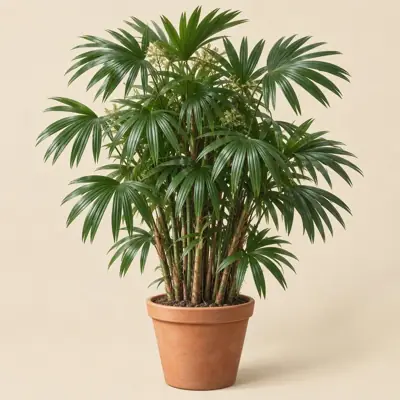
Overview
Rhapis excelsa is an evergreen, clump-forming perennial palm with underground rhizomes that produce multiple slender, upright stems.
Origin and habitat
Sources differ on its native range, describing it as extending from southern China to northern Vietnam. Sources also differ in their habitat accounts, which include the understory and slopes of lowland moist or dry forests. It favors warm, humid, shaded conditions and can also adapt to lower-light indoor conditions.
Characteristics
Sources differ on mature height, placing it at about 250–400 cm, while a single source reports a mature spread of about 250–400 cm. It is reported to grow slowly, with evergreen, dark green, palmate leaves that have pronounced longitudinal folds, deep divisions into narrow to broader segments, and slender petioles; sources differ on details of the segments, which may become more numerous on mature plants and have finely divided or serrated tips. Sources differ in describing its small yellow to pale-yellow flowers in inflorescences, though most describe the plants as dioecious; flowering occurs from late spring through summer. Sources differ on the mature fruit color, describing the small, fleshy, spherical to elliptical fruits as white or yellow.
Light
Rhapis excelsa grows in partial shade to bright indirect light and tolerates deeper shade; strong direct sunlight should be avoided because it can scorch the leaves.
Watering
Water regularly during the growing period and maintain moderate moisture, while using a well-drained medium and avoiding overwatering; reduce watering in winter.
Temperature and dormancy
A single source reports a minimum temperature of about 0 °C; sources are few.
Growing medium and mounting
Use a well-drained loamy medium; sources specify slightly acidic to neutral conditions and also give a seed-sowing medium combining leaf mold and river sand.
Feeding
Apply a balanced fertilizer during the growing season; sources variously recommend slow-release fertilizer or monthly applications of balanced liquid fertilizer.
Propagation
Rhapis excelsa can be propagated by seed or division, and it also produces suckers from underground rhizomes. Propagation sources also give germination and sowing-temperature guidance, but these figures are qualitative here and are therefore not specified numerically.
Common problems
Potential pests include greenhouse red spider mite, scale insects, fern scale, greenhouse thrips, banded greenhouse thrips, and root mealybugs. It is generally reported to have few diseases. It tolerates overwatering poorly, and strong direct sunlight can scorch the leaves. Strong sunlight should be avoided; it is described as more cold-tolerant than many palms, and sources also indicate that frost protection can aid overwintering.
Identification
Rhapis excelsa forms clumps of multiple upright, bamboo-cane-like stems from underground rhizomes; the stems often retain fibrous leaf sheaths, and the leaves are deeply divided and palmate.
Photos


Sources
- Wikipedia (en): Rhapis excelsa — CC BY-SA 4.0 · link
- 維基百科:棕竹 — CC BY-SA 4.0 · link
- Wikipedia (ja): カンノンチク — CC BY-SA 4.0 · link
- Wikipedia (fr): Rhapis excelsa — CC BY-SA 4.0 · link
- Wikipedia (es): Rhapis excelsa — CC BY-SA 4.0 · link
- GBIF descriptions: Lista de especies de plantas exóticas y trasplantadas de Colombia; Catálogo de Plantas y Líquenes de — per dataset · link
- NC State Plant Toolbox: Rhapis excelsa — copyright (facts only) · link
- Useful Tropical/Temperate Plants: Rhapis excelsa — CC BY-NC-SA 3.0 (facts only) · link
- RHS Plants: Rhapis excelsa — © RHS, facts only · link
- USDA PLANTS Database: Rhapis excelsa — Public domain (US Government work) · link