
southern Indian azalea (Rhododendron indicum)
Rhododendron indicum is a low, densely branched, compact evergreen to semi-evergreen shrub and a woody perennial.
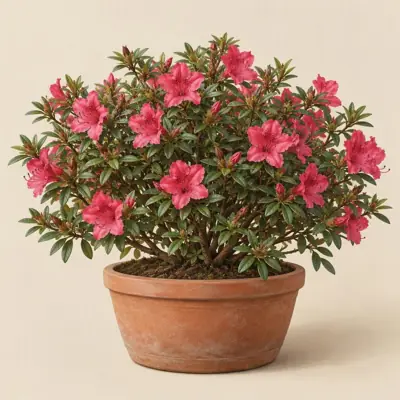
Overview
Rhododendron indicum is a low, densely branched, compact evergreen to semi-evergreen shrub and a woody perennial.
Origin and habitat
Sources differ in describing its native range in Japan, with accounts placing it mainly from central to western Honshu through Shikoku, Kyushu, and Yakushima, while some describe the range more broadly as central and southern Japan. Its natural habitats include rocky sites along streams and in gorges, where it can root in rock crevices along riverbanks. It is reported to be native to warm-temperate parts of Japan, with cold tolerance differing among forms.
Characteristics
Sources differ on mature height, placing it at about 50–200 cm, while mature spread is 50–100 cm; growth is reported to be slow. The small, relatively firm, lance-shaped leaves are alternate, green and glossy, and may turn red or purplish red in autumn; the plant produces spring and summer leaves, some summer leaves can persist through winter, and the foliage and branches may bear reddish-brown hairs. The funnel-shaped flowers are often solitary or paired and range from bright pink and reddish pink to burgundy; flowering is mainly from late spring to early summer, with some plants occasionally flowering again in autumn. The fruit is reported to be a long, ovoid capsule that matures later in the year.
Light
Rhododendron indicum grows in partial sun to dappled shade.
Watering
Keep the soil moist but well drained; it should not dry out completely, and prolonged waterlogging or excessively wet soil should be avoided.
Temperature and dormancy
With few sources available, a minimum temperature of about -20 °C is reported.
Growing medium and mounting
Use humus-rich, acidic, well-drained soil that retains moisture; loamy or sandy soils can be suitable, while calcareous, excessively dry, or persistently wet and heavy media should be avoided.
Feeding
It is generally recommended to avoid excessive fertilizing.
Propagation
It is reported to be propagated from seed or from semi-ripe cuttings taken in late summer.
Common problems
Potential pests include aphids, stem borers, lace bugs, leafhoppers, mealybugs, mites, nematodes, scale insects, thrips, whiteflies, weevils, and caterpillars. Possible diseases include root rot, crown rot, canker, leaf spot, rust, and powdery mildew; some cultivars are susceptible to Phytophthora root rot. Poor drainage, overwatering, or excessive fertilizing is reported to cause growth problems, while Phytophthora root rot can cause leaf drop, reduced vigor, branch dieback, and wilting. Sources differ on weather sensitivity, describing flowers and young shoots as vulnerable to late frost and recommending avoidance of frost pockets and strong winds; the plant is also described as intolerant of drought.
Identification
Rhododendron indicum is reported to be low and compact, with reddish-brown hairs on its branches and foliage and small leaves often densely arranged in layers; its flowers are axillary and funnel-shaped, with slender, sharply pointed sepals.
Photos


Sources
- Wikipedia (en): Rhododendron indicum — CC BY-SA 4.0 · link
- Wikipedia (ja): サツキ — CC BY-SA 4.0 · link
- NC State Plant Toolbox: Rhododendron indicum — copyright (facts only) · link
- Useful Tropical/Temperate Plants: Rhododendron indicum — CC BY-NC-SA 3.0 (facts only) · link
- RHS Plants: Rhododendron indicum — © RHS, facts only · link