
Jagged Germanderwort (Riccardia chamedryfolia)
Riccardia chamedryfolia is a non-vascular thalloid liverwort with a creeping to slightly ascending thallus; it can grow terrestrially in moist environments, is occasionally submerged, and is also cultivated as an ornamental freshwater aquarium plant. It is reported to be long-lived.
Overview
Riccardia chamedryfolia is a non-vascular thalloid liverwort with a creeping to slightly ascending thallus; it can grow terrestrially in moist environments, is occasionally submerged, and is also cultivated as an ornamental freshwater aquarium plant. It is reported to be long-lived.
Origin and habitat
Sources differ in their accounts of its distribution, while supporting its presence in Europe, North Africa, Asia, and North America; records identify it as native to Taiwan and North America and also document it in Macaronesia, Russia, China, and Japan. It mainly inhabits damp to wet environments, including springs, stream and river margins and other watersides, wet rocks, tree roots and bases, soil, sand, humus, alkaline-rich peatlands, and peat workings; it favors dark to partly shaded sites but can also occur in more open wetlands, and aquatic or occasionally submerged forms occur in wet peatlands, marshes, along rivers, and at watersides. It is reported to have a northern-temperate distribution and to be closely associated with highly moist environments.
Characteristics
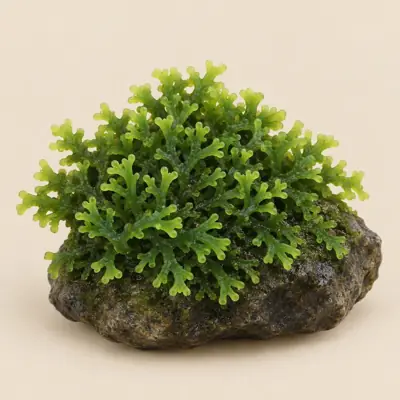
It has no true leaves; the plant body is an irregular dark-green to olive-green thallus, often pale green at the tips, with repeated branching and tongue-shaped branches with rounded tips. It does not flower and has short male branches and still shorter, ciliate female branches.
Light
Dark to partly shaded conditions are typical, although in the wild it can also occur in more open, better-lit moist habitats.
Watering
It requires a consistently damp to wet growing medium or environment; in nature it commonly occurs in places kept wet by flowing water, at springs, and along watersides, and in some habitats it can grow aquatically or submerged.
Growing medium and mounting
It can grow on moist organic substrates, soil, sand, and humus, as well as on tree roots, tree bases, and rocks; its habitat is also described as often alkaline-rich but relatively low in lime.
Common problems
It is reported to be a relatively weak competitor in the wild and, after appearing as a pioneer liverwort in disturbed sites, may quickly become covered by other bryophytes; habitat disturbance, watercourse modification, water pollution, and intensive agriculture are also associated with population declines in some regions. It is closely associated with moist to very wet environments, and the sources provide no quantified limits for drought, cold, or heat tolerance.
Identification
The thallus is irregular and repeatedly branched, with a relatively thick central region, a flatter underside and convex upper side, and a margin with few or no rows of transparent cells; nearly all epidermal cells contain brown oil bodies. At the thallus tip, the oil bodies span the width of the lobes, and the branches lack conspicuous transparent wings, features that can distinguish Riccardia chamedryfolia from Riccardia multifida.
Photos


Sources
- Wikipedia (en): Riccardia chamedryfolia — CC BY-SA 4.0 · link
- Wikipedia (de): Buchtiges Riccardimoos — CC BY-SA 4.0 · link
- GBIF descriptions: Validated red lists of Flanders, Belgium; New bryophytes for Tunisia (North Africa). Part 2: other f — per dataset · link
- TaiCOL 臺灣物種名錄: Riccardia chamedryfolia — CC BY 4.0 · link
- USDA PLANTS Database: Riccardia chamedryfolia — Public domain (US Government work) · link