
Damask Rose (Rosa hybrid)
Rosa is reported to be a perennial woody deciduous shrub or vine, with different kinds and cultivars taking climbing, trailing, bushy, creeping, or upright forms.
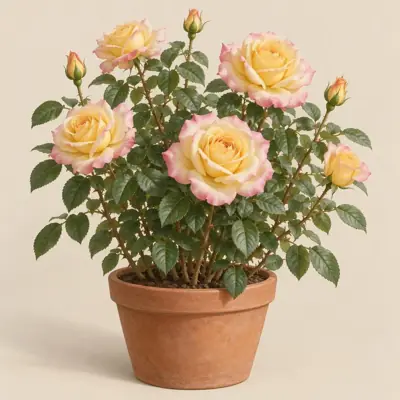
Overview
Rosa is reported to be a perennial woody deciduous shrub or vine, with different kinds and cultivars taking climbing, trailing, bushy, creeping, or upright forms.
Origin and habitat
Rosa is reported to be native to temperate and subtropical regions of the Northern Hemisphere, including North America, Europe, and Asia. It is reported to be adapted to temperate to subtropical environments and to tolerate heat and frost.
Characteristics
With few sources available, mature height is reported at about 30.48–243.84 cm and mature spread at about 60.96–182.88 cm. The leaves are reported to be alternate and pinnately compound, with serrated leaflet margins. Flower parts are reported to commonly occur in multiples, with flowers that may be red, orange, yellow, pink, purple, or white and are often fragrant. Rosa is reported to form rose hips, while the hard achenes inside are the true fruits.
Light
Rosa is reported to grow in full sun.
Temperature and dormancy
Rosa is reported to be frost hardy.
Growing medium and mounting
Rosa is reported to grow in well-drained, organic-rich soil that is acidic to neutral.
Propagation
Grafting is reported to be the recommended propagation strategy.
Common problems
Reported common pests include Fuller rose beetle, Japanese beetle, rose chafer, thrips, southern red mite, and twospotted spider mite; the source also lists rose aphid, potato aphid, and roseslug or rose sawfly among the problems. Reported common diseases include gray mold, Phytophthora diseases, powdery mildew, leaf spot, and anthracnose; the source also lists southern blight. White-tailed deer and cottontail rabbits are reported to be capable of causing damage. Rosa is reported to tolerate heat and frost, with hardening for overwintering beginning in late summer.
Identification
Rosa is reported to typically have prickles rather than true thorns on its stems, along with alternate pinnately compound leaves with serrated leaflets and flower parts commonly occurring in multiples.
Sources
- NC State Plant Toolbox: Rosa (genus-level) — copyright (facts only) · link