
Cuban Royal Palm (Roystonea regia)
Roystonea regia is a tall, single-trunked, unbranched evergreen palm tree. It is reported to be perennial.
Overview
Roystonea regia is a tall, single-trunked, unbranched evergreen palm tree. It is reported to be perennial.
Origin and habitat
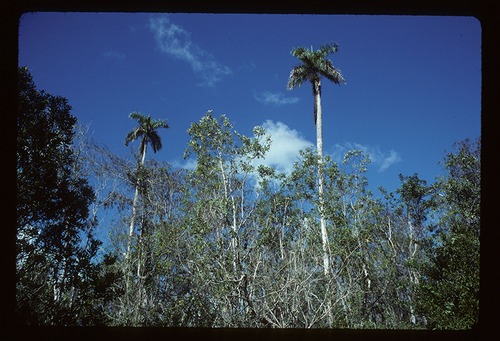
Sources differ on its native range, describing it mainly as including Cuba, Florida, parts of Mexico, Central America, and some Caribbean islands, with records also including Belize, Honduras, the Cayman Islands, and the Yucatán Peninsula of Mexico. It occurs in rainforests, woodlands, open savannas, and moist sites; in Cuba it grows on hills, in valleys, and in fertile, moist mountain areas, while in Florida it occurs in hammock habitats formed on limestone rises in the Everglades, and it also commonly enters disturbed environments. It is a lowland tropical plant especially adapted to areas of high rainfall and is widely cultivated in tropical and subtropical regions.
Characteristics
Sources differ on mature height, placing it at about 2000–3000 cm. Its growth rate is reported to be moderate to relatively fast. Sources differ in their descriptions of the foliage, but the large pinnate compound leaves are concentrated at the top of the crown, and their sheaths form a conspicuous, smooth green crownshaft. Sources differ in descriptions of the large, branched inflorescences; the flowers are described as white, creamy white, or yellowish white, with male and female flowers on the same plant.
Light
It is reported to prefer full sun.
Watering
It prefers high rainfall and moist conditions, but requires well-drained soil; watering should be reduced in winter because excess moisture may cause root rot.
Temperature and dormancy
A single source reports a minimum temperature of about -2 °C; sources are few.
Growing medium and mounting
It is reported to prefer well-drained soil.
Propagation
It is reported to be propagated by seed, with mature, fresh seed preferred for sowing and germination occurring after a period of time.
Common problems
Excess moisture in winter is reported to cause root rot, while large leaves falling from a height may pose an injury risk. It is a tropical plant that can occasionally tolerate light frost, and overwatering should be avoided in winter.
Identification
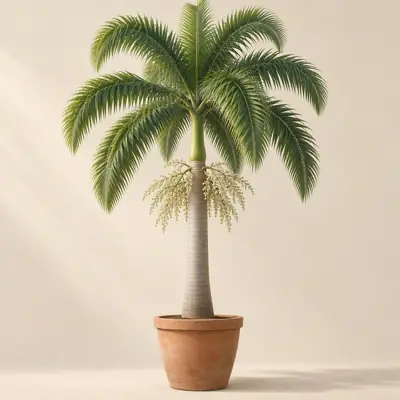
It is reported to have a tall, straight trunk with a smooth, grayish-white surface and localized swelling, topped by a conspicuous elongated green crownshaft and a crown of large pinnate leaves.
Photos


Sources
- Wikipedia (en): Roystonea regia — CC BY-SA 4.0 · link
- 維基百科:王棕 — CC BY-SA 4.0 · link
- Wikipedia (de): Königspalme — CC BY-SA 4.0 · link
- Wikipedia (fr): Roystonea regia — CC BY-SA 4.0 · link
- Wikipedia (es): Roystonea regia — CC BY-SA 4.0 · link
- Useful Tropical/Temperate Plants: Roystonea regia — CC BY-NC-SA 3.0 (facts only) · link
- USDA PLANTS Database: Roystonea regia — Public domain (US Government work) · link