
African-violet (Saintpaulia ionantha)
Saintpaulia ionantha is an evergreen tropical herbaceous plant with rosette growth; wild forms range from rosette-forming to creeping and stem-forming, while cultivated forms are mainly rosette-forming or trailing. It is an evergreen perennial herb.
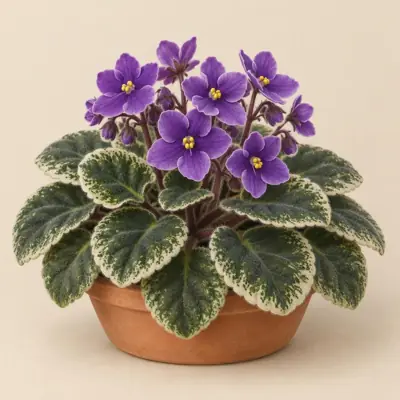
Overview
Saintpaulia ionantha is an evergreen tropical herbaceous plant with rosette growth; wild forms range from rosette-forming to creeping and stem-forming, while cultivated forms are mainly rosette-forming or trailing. It is an evergreen perennial herb.
Origin and habitat
Sources differ in their accounts of its native range in Tanzania, Africa, describing eastern and southwestern Tanzania and specifically recording the Usambara Mountains as native habitat; it is widely cultivated worldwide. Wild plants are reported to grow in the shaded herb layer of forests or in moist rocky habitats. It occurs in tropical conditions, does not tolerate frost, and is suited to protected, warm environments.
Characteristics
Sources differ on mature height, placing it at about 10–20 cm, while mature spread is 10–50 cm. Leaves are generally arranged in a basal rosette and borne on petioles; they range from fleshy to very thin, from ovate or elliptic to nearly round, with a heart-shaped base and varying degrees of hairiness, while cultivated plants are often described as having nearly round, fleshy, hairy green leaves whose undersides may be reddish green. The flowers are bisexual and bilaterally symmetrical, with a tubular, upper-and-lower-lipped corolla; wild forms have fertile stamens with bright yellow anthers, while cultivated forms include red, purple, blue, white, and pink flowers as well as single, semi-double, double, ruffled, star-shaped, bee-shaped, cup-shaped, and bell-shaped forms. Under suitable cultivation it can flower throughout the year, and the fruit is reported to be a capsule ranging from broadly ovate to narrowly cylindrical, with seeds bearing wart-like structures and longitudinal ridges.
Light
Provide bright filtered light or partial shade and avoid strong direct sunlight; indoors it can be placed by an east- or west-facing window.
Watering
Keep the growing medium moist but well drained, allowing the surface to dry between waterings, and water more sparingly in winter. Water can be supplied from the bottom of the pot, while prolonged wetting of the leaves should be avoided; standing water and overwatering can cause rot.
Growing medium and mounting
Use a fertile, fast-draining growing medium; a mixture based on sphagnum peat, vermiculite, and perlite is described, while RHS also lists loamy, moist but well-drained, acidic to neutral conditions.
Feeding
A highly fertile growing medium is needed for continued reblooming, and a high-potassium fertilizer can be applied during the growing season.
Propagation
It is reported to be propagated from leaf cuttings in summer.
Common problems
Reported pests include mealybugs, thrips, weevils, cyclamen or tarsonemid mites, and greenhouse leafhoppers. Crown and root rots and grey mould may occur, and RHS also lists a risk of powdery mildew. Overwatering is a major cultivation problem and can cause the plant to rot, while water remaining on the leaves can leave spots or ring marks. It does not tolerate frost, dry air, or very cold irrigation water; sources also indicate that sufficiently low night temperatures can suppress growth and lead to a longer recovery period.
Identification
Hairy leaves form a basal rosette from the center of the plant, and flowers are commonly in blue-purple to red hues; typical flowers have a tubular, bilaterally symmetrical corolla and conspicuous bright yellow anthers.
Photos


Sources
- GBIF Backbone: Saintpaulia ionantha H.Wendl. — CC BY 4.0 · link
- Wikipedia (en): Streptocarpus ionanthus — CC BY-SA 4.0 · link
- Wikipedia (en): Saintpaulia ionantha — CC BY-SA 4.0 · link
- Wikipedia (de): Usambaraveilchen — CC BY-SA 4.0 · link
- Wikipedia (fr): Saintpaulia ionantha — CC BY-SA 4.0 · link
- GBIF descriptions: Lista de especies de plantas exóticas y trasplantadas de Colombia; Catálogo de Plantas y Líquenes de — per dataset · link
- NC State Plant Toolbox: Saintpaulia ionantha — copyright (facts only) · link
- TaiCOL 臺灣物種名錄: Saintpaulia ionantha — CC BY 4.0 · link
- RHS Plants: Saintpaulia ionantha — © RHS, facts only · link