
pineapple sage (Salvia elegans)
Salvia elegans is an upright, clump-forming perennial herb to subshrub or shrub, with stems that may become somewhat woody. It is perennial but has relatively low cold tolerance and is often grown as an annual in cold regions.
Overview
Salvia elegans is an upright, clump-forming perennial herb to subshrub or shrub, with stems that may become somewhat woody. It is perennial but has relatively low cold tolerance and is often grown as an annual in cold regions.
Origin and habitat
Sources differ on its native range, describing it as extending from Mexico to Guatemala. Sources differ on its habitat, describing open areas or forest edges in montane pine, oak, and mixed pine-oak forests. It is native to mid- to high-elevation environments in Central America and, although relatively cold-sensitive, can grow as a perennial in milder climates without severe frost.
Characteristics
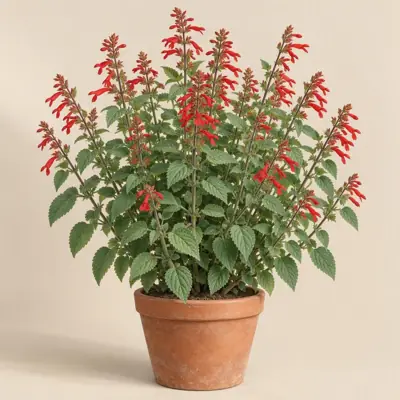
Sources differ on mature height, reporting about 80–200 cm, while the few available sources report a mature spread of about 90–120 cm. The opposite, ovate leaves have serrated margins and soft hairs, and release a pronounced pineapple-like fragrance when crushed. The slender, tubular, two-lipped flowers are red to bright scarlet, occur in terminal inflorescences, and can attract flower visitors such as hummingbirds and butterflies. Sources differ on flowering time: it flowers mainly from late summer through autumn, may continue into winter in warm or frost-free conditions and even into spring in some regions, while some cultivars may begin flowering in summer; the fruit is reported to be a schizocarp composed of separate segments.
Light
Salvia elegans grows in full sun, and artificial lighting at night may interfere with its short-day flowering response.
Watering
Maintain moderate moisture while avoiding waterlogging, and use a well-drained growing medium; the plant has some drought tolerance, but insufficient water can cause leaves to wilt, curl, or drop, while excessive moisture may cause root problems.
Temperature and dormancy
The few available sources differ on minimum temperature, reporting about -5 °C. It tolerates brief light frost and is described as relatively cold-sensitive.
Growing medium and mounting
It prefers fertile, loose, well-drained soil and can adapt to sandy, loamy, and chalky soils with conditions ranging from acidic to alkaline.
Feeding
It is generally reported to need only moderate fertility, while excessive fertilizing may reduce flowering.
Propagation
It can be propagated by stem, softwood, or semi-ripe cuttings, by seed, or by dividing underground stems; cuttings are generally more commonly recommended.
Common problems
It is reported to be susceptible to damage from slugs, snails, capsid bugs, aphids, greenhouse red spider mites, and greenhouse whiteflies. Insufficient water can cause leaves to wilt, curl, or drop; excessive moisture can cause root problems; excessive fertilizing may reduce flowering; and artificial lighting at night may interfere with flower-bud formation under short-day conditions. It has relatively low cold tolerance, with severe frost potentially killing the above-ground growth, and tall stems are also susceptible to wind breakage.
Identification
Key identifying features are the pineapple-like fragrance released by crushed leaves, bright red slender tubular flowers, and upright stems.
Photos


Sources
- Wikipedia (en): Salvia elegans — CC BY-SA 4.0 · link
- Wikipedia (ja): パイナップルセージ — CC BY-SA 4.0 · link
- Wikipedia (de): Honigmelonen-Salbei — CC BY-SA 4.0 · link
- Wikipedia (fr): Salvia elegans — CC BY-SA 4.0 · link
- Wikipedia (es): Salvia elegans — CC BY-SA 4.0 · link
- NC State Plant Toolbox: Salvia elegans — copyright (facts only) · link
- 農業知識入口網 植物圖鑑: Salvia elegans — © MOA, facts only · link
- Useful Tropical/Temperate Plants: Salvia elegans — CC BY-NC-SA 3.0 (facts only) · link
- RHS Plants: Salvia elegans — © RHS, facts only · link
- Top Tropicals catalog: Salvia elegans — © Top Tropicals LLC (facts only) · link