
mealycup sage (Salvia farinacea)
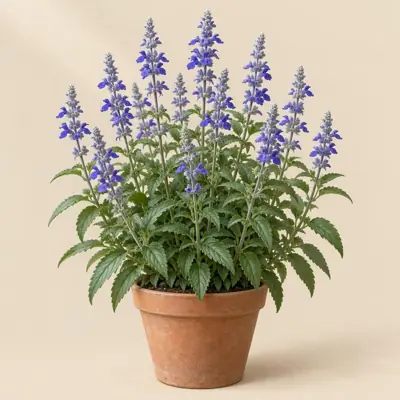
Salvia farinacea is an upright, clump-forming herbaceous plant with slender flower spikes. It is a perennial herb, but in temperate regions where it cannot overwinter it is often grown as an annual flowering plant.
Overview
Salvia farinacea is an upright, clump-forming herbaceous plant with slender flower spikes. It is a perennial herb, but in temperate regions where it cannot overwinter it is often grown as an annual flowering plant.
Origin and habitat
Sources differ on the precise native range, describing it broadly as North American, mainly around Texas in the south-central United States and northeastern Mexico, with some also specifically listing Oklahoma, New Mexico, and Nuevo León in Mexico. Its native habitats include prairies, plains, grasslands, pastures, and woodland edges. It can be grown as a perennial in warm regions, while in colder temperate areas where it cannot safely overwinter it is generally grown as an annual flowering plant.
Characteristics
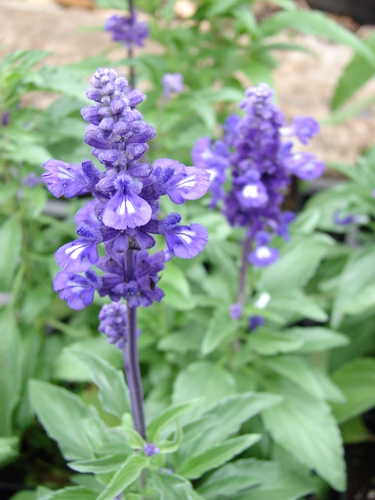
Sources differ on mature size, giving a height of about 50–90 cm and, from few sources, a spread of about 30.48–60.96 cm. Sources describe the leaves somewhat differently: they are green to silvery green, narrow or ovate-lanceolate to lanceolate, may be coarsely toothed, are relatively glossy above, may be hairy beneath, and are aromatic. The bilabiate flowers are densely borne on slender inflorescences and are commonly blue, violet-blue, or purple, with white and blue-and-white forms also occurring; the calyx may be purple and conspicuously hairy. Sources differ on flowering season, describing flowering mainly from spring into summer or from summer into autumn, with some cultivated plants flowering intermittently from spring until frost and records of year-round flowering in Taiwan.
Light
Salvia farinacea grows in full sun to partial sun, with horticultural cultivation favoring a well-lit setting.
Watering
It prefers moist but well-drained soil; once established it can tolerate drier conditions and dry clay, while waterlogging should be avoided during rainy summers.
Temperature and dormancy
Sources differ on its USDA hardiness classification.
Growing medium and mounting
It prefers fertile, well-drained soil and can grow in loam or sandy soil while also tolerating dry clay; the soil may be acidic, neutral, or alkaline.
Feeding
It is reported that fertilizer can be applied frequently during the growing period.
Propagation
It can be propagated by seed or cuttings; suitable sowing periods include spring, autumn, and winter, and vigorous new shoots can also be taken as cuttings. Seeds germinate under suitable warm conditions after a period following sowing.
Common problems
It is generally reported that dense growth may require pruning to improve air circulation, and that waterlogging and direct exposure to heavy rain should be avoided during very rainy summers. It tolerates heat and drought, but generally cannot overwinter reliably in cold regions and is instead grown as an annual; excessive summer rain and waterlogging should be avoided.
Identification
Powdery-looking whitish or bluish-white hairs on the calyx and upper stems are distinguishing features; the leaves are relatively glossier than those of many sages, and the calyx can remain after the flowers fall.
Photos


Sources
- Wikipedia (en): Salvia farinacea — CC BY-SA 4.0 · link
- 維基百科:粉萼鼠尾草 — CC BY-SA 4.0 · link
- Wikipedia (de): Mehliger Salbei — CC BY-SA 4.0 · link
- Wikipedia (fr): Salvia farinacea — CC BY-SA 4.0 · link
- Wikipedia (es): Salvia farinacea — CC BY-SA 4.0 · link
- NC State Plant Toolbox: Salvia farinacea — copyright (facts only) · link
- TaiCOL 臺灣物種名錄: Salvia farinacea — CC BY 4.0 · link
- 農業知識入口網 植物圖鑑: Salvia farinacea — © MOA, facts only · link
- RHS Plants: Salvia farinacea — © RHS, facts only · link
- USDA PLANTS Database: Salvia farinacea — Public domain (US Government work) · link