
kitchen sage (Salvia officinalis)
Salvia officinalis is a perennial, evergreen, aromatic, much-branched subshrub to semi-woody shrub, although sources describe its habit differently.
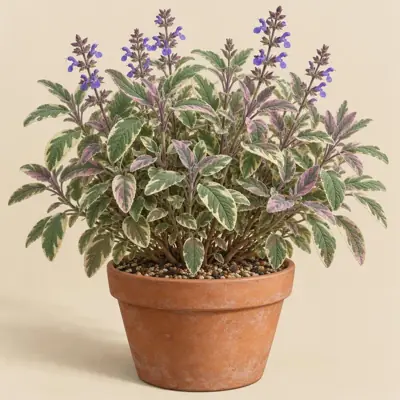
Overview
Salvia officinalis is a perennial, evergreen, aromatic, much-branched subshrub to semi-woody shrub, although sources describe its habit differently.
Origin and habitat
Sources differ on details of the native range, describing the species as native to the Mediterranean region and southern Europe and subsequently cultivated and recorded as naturalized in many parts of the world. It occurs in grassland, scrub, hillsides, dry grassland, and rocky places, including dry, relatively infertile environments from sea level into mountainous areas in Mediterranean Europe. It is adapted to conditions represented by sunny, relatively dry, well-drained Mediterranean-type habitats.
Characteristics
Sources differ on mature height, with the few reported values giving a range of about 30–100 cm; mature spread is 50–100 cm. The opposite leaves are mainly oblong to ovate, wrinkled and hairy; sources differ somewhat on coloration, with the species typically described as gray-green to whitish green, while 'Tricolor' has gray-green or green leaves with creamy-white variegation and young leaves that may be tinged purple, and another account describes white and yellow variegation. Sources differ on flower color: the typically two-lipped flowers are commonly blue to blue-violet or pale blue but may also be pink, white, or purple, and are borne in terminal inflorescences; flowering is described from late spring through summer. The fruit is reported to be a schizocarp composed of nutlets that are nearly spherical and dark brown.
Light
Full sun is preferred, although some sources also indicate that partial shade is acceptable.
Watering
The growing medium should be well drained, with moderate to relatively dry conditions and without prolonged wetness or poor drainage; once established, the plant can tolerate some drought.
Temperature and dormancy
Sources differ on the plant's hardiness. It is reported to be frost tender; keep above freezing.
Growing medium and mounting
It grows in well-drained chalky, loamy, or sandy soil that may be acidic, neutral, or alkaline, and it can tolerate relatively infertile soil.
Propagation
It is reported to be propagated by cuttings, with summer cuttings described as readily successful.
Common problems
Southern blight is reported to occur. Wet or poorly drained soil is reported to be unsuitable, and plants may become leggy and require appropriate pruning to maintain their form. The plant prefers sunny, relatively dry, well-drained conditions, while accounts of its cold tolerance differ.
Identification
'Tricolor' can be distinguished by aromatic gray-green to green variegated leaves with creamy-white markings and young growth that may be tinged purple; another account describes green leaves with white and yellow markings. The base of the plant gradually becomes woody.
Photos


Sources
- GBIF Backbone: Salvia officinalis L. — CC BY 4.0 · link
- Wikipedia (en): Salvia officinalis — CC BY-SA 4.0 · link
- 維基百科:藥用鼠尾草 — CC BY-SA 4.0 · link
- Wikipedia (ja): セージ — CC BY-SA 4.0 · link
- Wikipedia (de): Echter Salbei — CC BY-SA 4.0 · link
- Wikipedia (fr): Sauge officinale — CC BY-SA 4.0 · link
- Wikipedia (es): Salvia officinalis — CC BY-SA 4.0 · link
- GBIF descriptions: Manual of the Alien Plants of Belgium; Database of Vascular Plants of Canada (VASCAN); Checklist of — per dataset · link
- NC State Plant Toolbox: Salvia officinalis — copyright (facts only) · link
- Wikipedia (it): Salvia officinalis — CC BY-SA 4.0 · link
- Wikipedia (nl): Echte salie — CC BY-SA 4.0 · link
- Wikipedia (pt): Salvia officinalis — CC BY-SA 4.0 · link
- Useful Tropical/Temperate Plants: Salvia officinalis — CC BY-NC-SA 3.0 (facts only) · link
- RHS Plants: Salvia officinalis — © RHS, facts only · link