
Yellow Pitcher Plant (Sarracenia flava)
Sarracenia flava is a stemless, rhizomatous, terrestrial carnivorous perennial herb.
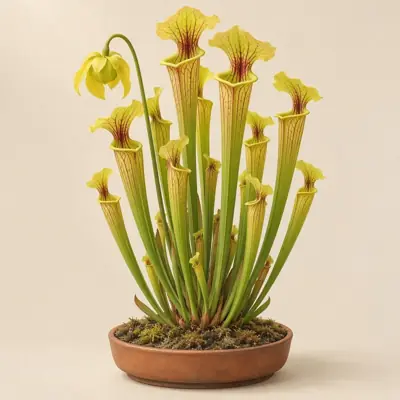
Overview
Sarracenia flava is a stemless, rhizomatous, terrestrial carnivorous perennial herb.
Origin and habitat
Sources differ on its native range; it is native to the southeastern United States, with its core distribution including southeastern Virginia, North Carolina, South Carolina, Georgia, Florida, and southeastern Alabama, and with isolated inland populations in North Carolina. It grows in wet pine savannas, wet prairies, seepage bogs, pocosin wetlands, and other bog environments, on sandy or peaty soils that are typically wet, acidic, and low in nitrogen. It is adapted to sunny wetland environments of southeastern North America and has a winter dormancy cycle.
Characteristics
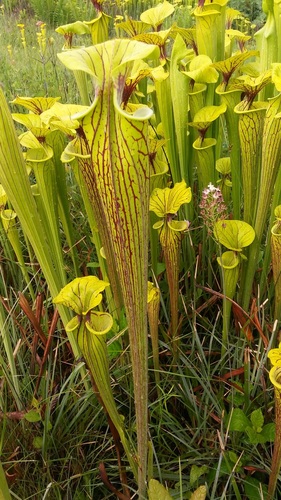
Sources differ, with few sources indicating a mature height of about 40–130 cm. The main leaves are reported to form upright tubular pitchers that are narrower below and widen toward the opening, with a lid that can reduce rain entry; coloration is highly variable and may be yellow-green, green, red-veined, or dark red, while flattened, sword-shaped, non-carnivorous leaves may form from late summer into autumn. Sources differ in their descriptions of the large, nodding flowers, which are mainly yellow, with strap-shaped to nearly obovate petals and an umbrella-shaped pistil; some sources also report a strong odor. Flowering occurs in spring, and the nearly spherical capsule is reported to mature later and contain many seeds.
Light
Full sun is preferred during the growing season, although cultivation in conditions from sun to partial sun is also reported.
Watering
Keep the medium continuously moist, and tray (bottom) watering can be used to maintain moisture, although NC State advises against an excessively waterlogged growing medium. For potted plants, rainwater or distilled water is preferred over tap water with more dissolved salts, while another source generally specifies pure water only (rain, RO or distilled).
Humidity and airflow
It is reported to need good airflow.
Temperature and dormancy
Sources differ, with few sources indicating a minimum temperature of about -10 °C. It is generally associated with hardiness zone conditions as reported by the source and requires cold winter dormancy.
Growing medium and mounting
Use an acidic medium that is low in nitrogen and nutrients and retains moisture; sources recommend peat or sphagnum moss with coarse sand, perlite, or vermiculite, as well as sphagnum moss alone and mixtures containing peat.
Feeding
Fertilizer is generally not used because it may harm the plant, and there is no need to feed it insects or food scraps artificially.
Propagation
It can be propagated by rhizome division or seed, with division being the more direct method; seed-grown plants take several years before first flowering.
Common problems
Aphids and mites are reported as possible pests, with aphids more likely under poor airflow and mites more likely in hot, dry conditions. Viral disease is reported to cause symptoms including distorted new leaves that fail to develop their normal form. Dry medium, excessive fertilizer, water containing more dissolved salts, and lack of cold winter dormancy are unfavorable, and indoor conditions are also unsuitable when they cannot provide enough sunlight and winter dormancy conditions. It needs continuously moist conditions and can tolerate some winter cold while requiring cold dormancy, but sources disagree on its minimum cold tolerance.
Identification
It is reported to have tall, upright tubular pitchers with broad lids and nectar-secreting lips at the openings; the leaves are often yellow-green and may have red veins. It is reported to attract insects with nectar and color, after which waxy slippery surfaces, downward- or inward-pointing hairs, and digestive fluid make escape difficult.
Photos


Sources
- GBIF Backbone: Sarracenia flava L. — CC BY 4.0 · link
- Wikipedia (en): Sarracenia flava — CC BY-SA 4.0 · link
- 維基百科:黄瓶子草 — CC BY-SA 4.0 · link
- Wikipedia (ja): キバナヘイシソウ — CC BY-SA 4.0 · link
- Wikipedia (de): Gelbe Schlauchpflanze — CC BY-SA 4.0 · link
- Wikipedia (fr): Sarracenia flava — CC BY-SA 4.0 · link
- Wikipedia (es): Sarracenia flava — CC BY-SA 4.0 · link
- GBIF descriptions: Guide to the Vascular Flora of the Savannas and Flatwoods of Shaken Creek Preserve and Vicinity (Pen — per dataset · link
- NC State Plant Toolbox: Sarracenia flava — copyright (facts only) · link
- Useful Tropical/Temperate Plants: Sarracenia flava — CC BY-NC-SA 3.0 (facts only) · link
- USDA PLANTS Database: Sarracenia flava — Public domain (US Government work) · link
- Tom's Carnivores: Sarracenia (genus-level) — © Tom's Carnivores, facts only · link
- NHK みんなの趣味の園芸 植物図鑑: Sarracenia flava — © NHK出版, facts only · link