
hooded pitcherplant (Sarracenia minor)
Sarracenia minor is a terrestrial, rhizomatous perennial carnivorous herb with an upright habit and tubular, pitcher-shaped trapping leaves.
Overview
Sarracenia minor is a terrestrial, rhizomatous perennial carnivorous herb with an upright habit and tubular, pitcher-shaped trapping leaves.
Origin and habitat
Sources differ on details of its native range, which is in North America in the southeastern United States, primarily extending from southern North Carolina through South Carolina and Georgia to Florida, with the southernmost populations extending into south-central Florida around Lake Okeechobee. It grows in moist, boggy, nutrient-poor environments, especially where nutrients such as nitrogen and phosphorus are scarce; some Florida populations also occur in relatively drier sites.
Characteristics
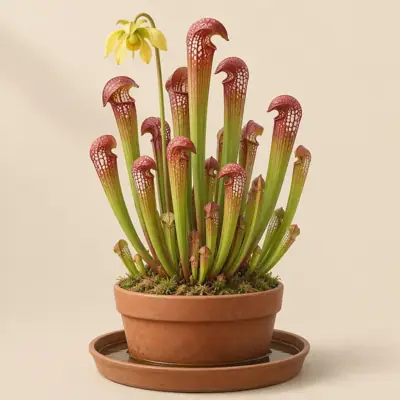
Sources differ and are few on mature height, reporting about 25–50 cm. The leaves are modified into upright, hollow, tubular pitchers with a forward-covering hood over the opening and translucent white patches on the upper rear surface; the pitchers are usually green but can turn copper-red to dark red toward the top in strong sunlight. The flowers are reported to be yellow to pale yellow and without a noticeable scent. Flowering is reported to occur in spring, and the fruit is reported to be a capsule that produces many seeds.
Light
Sarracenia minor requires full sun. It is reported that partial sun can result in poorer leaf coloration and may cause the pitchers to droop.
Watering
Keep the growing medium continuously moist to wet and do not allow it to dry out; rainwater or distilled water can be used, and the crown should not be below the water surface. Pure water only (rain, RO or distilled) is generally recommended. Tray (bottom) watering is reported to be compatible with this plant. Keep wet.
Temperature and dormancy
Sarracenia minor is reported to require cold winter dormancy.
Growing medium and mounting
An acidic, humus-rich, continuously moist bog-type growing medium is reported to be suitable; container-grown plants can use mixtures of peat with sand or peat with perlite. Peat with perlite is a supported substrate type.
Feeding
It is reported that feeding insects is unnecessary.
Propagation
The plant is reported to spread outward by rhizomes.
Common problems
Partial sun is reported to cause poor leaf coloration and drooping pitchers; allowing the growing medium to dry out does not meet its cultivation needs, and the crown should not be submerged below the water surface.
Identification
The most distinctive features are the hood covering the pitcher opening and the translucent white patches on the upper part of the pitcher. These patches cause insects inside the trap to move toward the light, making it difficult for them to escape through the actual pitcher opening.
Photos


Sources
- Wikipedia (en): Sarracenia minor — CC BY-SA 4.0 · link
- 維基百科:小瓶子草 — CC BY-SA 4.0 · link
- Wikipedia (de): Kleine Schlauchpflanze — CC BY-SA 4.0 · link
- Wikipedia (fr): Sarracenia minor — CC BY-SA 4.0 · link
- Wikipedia (es): Sarracenia minor — CC BY-SA 4.0 · link
- NC State Plant Toolbox: Sarracenia minor — copyright (facts only) · link
- USDA PLANTS Database: Sarracenia minor — Public domain (US Government work) · link
- Tom's Carnivores: Sarracenia (genus-level) — © Tom's Carnivores, facts only · link
- NHK みんなの趣味の園芸 植物図鑑: Sarracenia (genus-level) — © NHK出版, facts only · link