
parrot pitcherplant (Sarracenia psittacina)
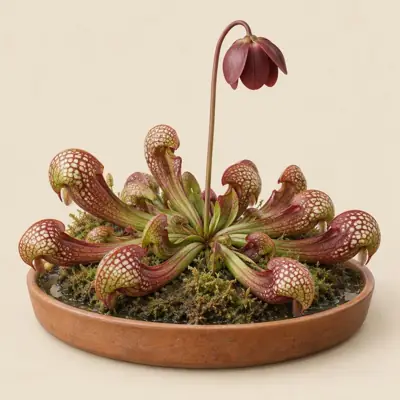
Sarracenia psittacina is a perennial, rhizomatous, herbaceous carnivorous plant whose trapping leaves lie close to the ground in a flattened rosette.
Overview
Sarracenia psittacina is a perennial, rhizomatous, herbaceous carnivorous plant whose trapping leaves lie close to the ground in a flattened rosette.
Origin and habitat
Sources differ in describing its native range in the southeastern United States, with more specific accounts extending from southeastern Georgia through the Florida Panhandle west to the southeastern tip of Louisiana, while broader accounts describe the southeastern coast or an area from South Carolina to Mississippi. It inhabits low-lying, acidic, nutrient-poor wetlands, including bogs, low wet areas in pine woods, and the margins of ponds or small waterways; native sites may be seasonally or temporarily flooded, and it often occurs with sphagnum moss. It is adapted to open wetlands of the southeastern United States coastal plain, can experience seasonal flooding, and favors abundant sunlight during the growing season.
Characteristics
Sources differ and are few on mature size, placing height at about 10–50 cm; a single source reports a spread of about 10–50 cm. Sources differ in their descriptions of the leaves: they are modified into tubular trapping pitchers that creep along the ground in a tight rosette, ending in an enlarged hollow hood with a small entrance and containing long downward-pointing or interlocking hairs; they are commonly green, red-green, or dark red, with red veins and translucent white patches. The solitary, nodding flowers are generally dark red to purplish red, with rounded petals, while an all-green form with yellow flowers is also recorded; flowering occurs in spring. The fruit is reported to be a capsule containing many small seeds.
Light
Full sun is preferred, with abundant light during the growing season; sources differ in noting that plants can grow with some shade in native habitat but become greener, while intense sun that causes excessive heat should be avoided in greenhouse cultivation.
Watering
Keep the growing medium evenly moist to wet and do not allow potted plants to dry out; pure water only (rain, RO or distilled) or other lime-free water is recommended because minerals and chemicals in ordinary tap water should be avoided. Tray (bottom) watering is reported to be suitable. In winter, the medium may be somewhat drier than during the growing season, while still maintaining appropriate moisture as described by the sources.
Humidity and airflow
Sarracenia psittacina needs good airflow.
Temperature and dormancy
A single source reports an RHS hardiness rating of H3 and indicates that the plant tolerates brief light frost. It has a cold winter dormancy.
Growing medium and mounting
Sources differ in describing an acidic, moist to wet, nutrient-poor medium, mentioning sandy soil, sand with peat, and sphagnum environments; RHS recommends an acidic peat-free potting medium with sustainably sourced moss.
Feeding
Fertilizing is not recommended, and there is no need to feed insects or other food artificially because the plant can catch its own food.
Propagation
Sarracenia psittacina can be propagated by division or seed, and cold stratification can aid germination.
Common problems
Potential pests include aphids, scale insects, mealybugs, and moth larvae, while genus-level information also mentions spider mites. Sources differ on disease occurrence: leaf spot and root rot may occur, genus-level cultivation information also records viral disease, while RHS describes the plant as generally having few diseases. Do not allow the potting medium to dry out; minerals and chemicals in household tap water may be unsuitable, so rainwater, distilled water, or lime-free water should be used. The plant tolerates seasonal or temporary flooding; outdoor cultivation should provide abundant sunlight and protection from cold winds, with additional protection requiring attention in colder conditions.
Identification
The pitchers lie horizontally along the ground and end in a nearly spherical or beak-like hollow hood with only a small entrance; translucent white patches can cause entering prey to mistake them for exits, while downward-pointing or interlocking internal hairs impede retreat. When flooded, the plant can also capture aquatic arthropods and tadpoles.
Photos


Sources
- Wikipedia (en): Sarracenia psittacina — CC BY-SA 4.0 · link
- 維基百科:鸚鵡瓶子草 — CC BY-SA 4.0 · link
- Wikipedia (de): Papageien-Schlauchpflanze — CC BY-SA 4.0 · link
- Wikipedia (fr): Sarracenia psittacina — CC BY-SA 4.0 · link
- NC State Plant Toolbox: Sarracenia psittacina — copyright (facts only) · link
- RHS Plants: Sarracenia psittacina — © RHS, facts only · link
- USDA PLANTS Database: Sarracenia psittacina — Public domain (US Government work) · link
- Tom's Carnivores: Sarracenia (genus-level) — © Tom's Carnivores, facts only · link
- NHK みんなの趣味の園芸 植物図鑑: Sarracenia (genus-level) — © NHK出版, facts only · link