
purple pitcherplant (Sarracenia purpurea)
Sarracenia purpurea is a carnivorous perennial herb with a rhizome and a rosette of leaves modified into pitcher-shaped traps. Sources differ in describing its perennial foliage: it can be evergreen but may lose some leaves during winter dormancy.
Overview
Sarracenia purpurea is a carnivorous perennial herb with a rhizome and a rosette of leaves modified into pitcher-shaped traps. Sources differ in describing its perennial foliage: it can be evergreen but may lose some leaves during winter dormancy.
Origin and habitat
Sources differ on the precise native range, but describe Sarracenia purpurea as native to North America and widespread in Canada and the United States, including eastern parts of the continent and the Great Lakes region; USDA also lists Alaska, Canada, the contiguous United States, and Saint Pierre and Miquelon as native areas. It primarily inhabits wet, acidic environments, including peat bogs, peat barrens, marshes, pine woodlands, and wet forest floors, often growing with sphagnum in nutrient-poor substrates. It is reported to be adapted to temperate and cold-temperate environments in North America, extending into Canada, and to be among the most widely distributed and more cold-tolerant species in its genus.
Characteristics
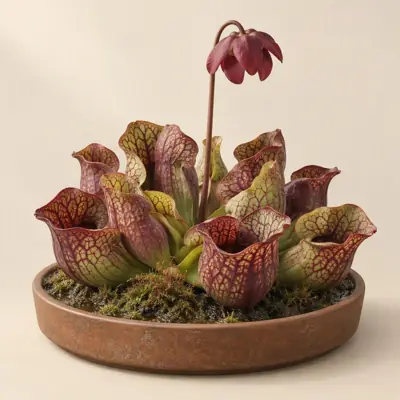
Sources differ, but mature height is reported at about 10–50 cm; sources are few for mature spread, which is reported at about 10–50 cm. Sources differ in their descriptions of the leaves: they form a rosette of hollow, upward-opening pitcher traps, are often green with reddish-purple or purple veining, have downward-pointing hairs inside, can collect rainwater, and vary markedly among subspecies. Sources differ in their descriptions of the flowers, which have petals and are often reddish-purple, dark red, or pale red and are borne above the pitcher leaves; flowering is generally reported in spring. The fruit is generally reported to be a capsule containing many small seeds.
Light
Full sun is preferred during the growing season, although sources differ and some describe cultivation in conditions ranging from sun to partial sun.
Watering
Keep the growing medium continuously moist to wet and do not allow potted plants to dry out; winter conditions can be slightly drier than during the growing season, but the medium should still not dry completely. Use rainwater, distilled water, or other low-mineral, lime-free water; pure water only (rain, RO or distilled) is generally recommended. Tray (bottom) watering is suitable.
Humidity and airflow
It is generally reported to need good airflow.
Temperature and dormancy
Sources differ, and the available source is limited, but a lower temperature of about -25 °C is reported. It is generally reported as RHS H6. Sarracenia purpurea has cold winter dormancy.
Growing medium and mounting
Sources differ on the medium, but describe acidic, low-fertility media that remain moist, including sphagnum, peat, coarse acidic sand, and sand with peat; RHS also recommends a peat-free acidic growing medium with sustainably sourced moss.
Feeding
Fertilizer is generally unnecessary, and there is no need to feed insects or other food artificially; the plant can catch its own food.
Propagation
Propagation can be by seed or division; a period of cold stratification can encourage seed germination, and shoots produced by the rhizome can also form new plants.
Common problems
Potential pests include aphids, scale insects, mealybugs, spider mites, and moth larvae. Leaf spot, root rot, and viral disease may occur, and viral disease can cause distorted or malformed new leaves. Dry growing medium is unfavorable, tap water containing higher levels of minerals or chemicals is unsuitable, and insufficient light can make the purple coloration less distinct. It is generally reported to be quite cold tolerant, although this varies among subspecies; the southern subsp. venosa is reported to tolerate warmer conditions and to have relatively less cold tolerance.
Identification
Distinctive features include short, stout, upward-opening pitcher leaves whose openings are not covered by the lid and which collect rainwater, often with reddish-purple veining; downward-pointing hairs inside the pitchers help prey slide downward and hinder escape.
Photos


Sources
- 維基百科:紫瓶子草 — CC BY-SA 4.0 · link
- Wikipedia (ja): ムラサキヘイシソウ — CC BY-SA 4.0 · link
- Wikipedia (de): Rote Schlauchpflanze — CC BY-SA 4.0 · link
- Wikipedia (fr): Sarracénie pourpre — CC BY-SA 4.0 · link
- Wikipedia (es): Sarracenia purpurea — CC BY-SA 4.0 · link
- GBIF descriptions: Manual of the Alien Plants of Belgium; Database of Vascular Plants of Canada (VASCAN); DAISIE - Inve — per dataset · link
- NC State Plant Toolbox: Sarracenia purpurea — copyright (facts only) · link
- Useful Tropical/Temperate Plants: Sarracenia purpurea — CC BY-NC-SA 3.0 (facts only) · link
- RHS Plants: Sarracenia purpurea — © RHS, facts only · link
- USDA PLANTS Database: Sarracenia purpurea — Public domain (US Government work) · link
- Tom's Carnivores: Sarracenia (genus-level) — © Tom's Carnivores, facts only · link
- NHK みんなの趣味の園芸 植物図鑑: Sarracenia purpurea — © NHK出版, facts only · link