
false Christmas cactus (Schlumbergera truncata)
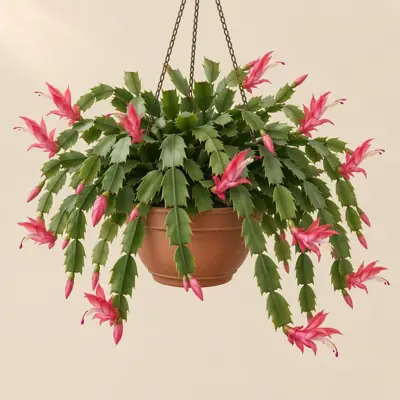
Schlumbergera truncata is a perennial evergreen, epiphytic, much-branched, shrubby succulent cactus that is occasionally rock-growing, with mature branches that may become trailing or pendent.
Overview
Schlumbergera truncata is a perennial evergreen, epiphytic, much-branched, shrubby succulent cactus that is occasionally rock-growing, with mature branches that may become trailing or pendent.
Origin and habitat
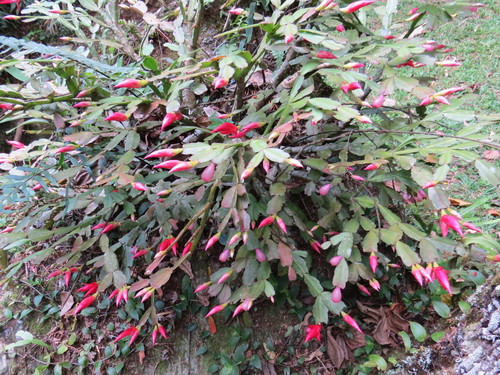
Schlumbergera truncata is endemic to Rio de Janeiro state and its coastal mountains in southeastern Brazil, where it has a restricted native range. It inhabits Atlantic and moist coastal forests, mainly growing on trees but also on rocks such as granite and gneiss, usually beneath the shade of the forest canopy. Its native environment is warm and humid, with sunlight filtered by the forest canopy, under subtropical to tropical moist-forest conditions.
Characteristics
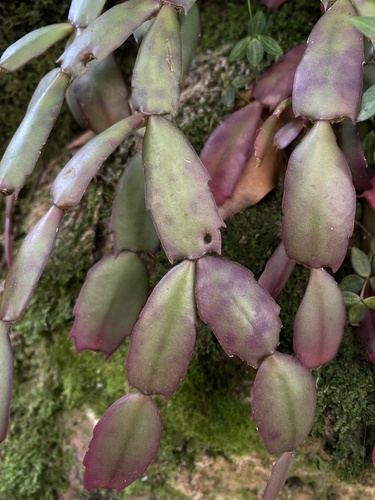
Sources differ on mature size, placing both height and spread at about 10–50 cm. It has no true leaves; instead, its green stems form flattened, leaf-like segments with toothed projections along the margins and ends and a distinctly truncated tip. Sources differ in their descriptions of the flowers and flowering period: flowers are borne at stem-segment tips, are elongated and bilaterally symmetrical, and occur in pink, red, orange, white, and purple, with cultivated forms also including yellow and bicolored flowers; flowering is described from autumn into winter, varying with cultivation conditions, and short days help induce flower buds. Sources differ on fruit details; mature fruits are described as red or pink and pear-shaped, with black, glossy seeds.
Light
It grows in bright light or part shade, with bright indirect light suitable; strong direct sunlight should be avoided in summer, while brighter light can be provided in winter. Short days and longer nights help promote flower-bud formation.
Watering
During active growth, maintain moderate moisture with good drainage and avoid overwatering; cultivation guidance also recommends allowing the surface to dry before watering and keeping conditions drier during the later, cooler part of the cycle.
Humidity and airflow
Schlumbergera truncata prefers high humidity.
Temperature and dormancy
Sources are few and differ on minimum-temperature guidance, with about 10 °C reported as a minimum. It is frost tender and not frost tolerant, and is generally reported to rest cool and dry in winter. A USDA hardiness-zone range is reported by a single source, while another single-source minimum-temperature value is also available.
Growing medium and mounting
As an epiphytic plant, it needs a fast-draining, well-aerated growing medium. Suitable media described in the sources include cactus or succulent potting mix, or mixtures containing vermiculite, perlite or pumice, and acidity-adjusted peat; the medium is described as acidic to neutral.
Feeding
Feed during active growth; the cited guidance varies in timing but describes reducing or stopping feeding later so that fertilizer effects decline before flower-bud formation.
Propagation
Propagation is recorded by stem cuttings, seed, and grafting. For cuttings, stem segments may be taken, the cut surface treated, and the cutting inserted into a well-drained medium.
Common problems
Potential pests include scale insects, mealybugs, slugs, caterpillars, and noctuid larvae. Disease problems are described as generally uncommon, although reddening stem segments accompanied by roots forming between segments may be associated with root rot. Overwatering can cause problems, strong summer light can yellow the stems, moving a plant after buds have formed can cause buds or flowers to drop, and excessive heating can also cause flower drop. Cold tolerance is weak and frost should be avoided; sources provide differing minimum-temperature guidance, and strong direct summer light should also be avoided.
Identification
Photosynthesis is carried out by flattened green stem segments whose ends are distinctly truncated and whose margins bear toothed projections; areoles at the tips produce new segments and flower buds, and the flowers are distinctly bilaterally symmetrical.
Photos


Sources
- Wikipedia (en): Schlumbergera truncata — CC BY-SA 4.0 · link
- 維基百科:蟹爪兰 — CC BY-SA 4.0 · link
- Wikipedia (de): Schlumbergera truncata — CC BY-SA 4.0 · link
- Wikipedia (fr): Schlumbergera truncata — CC BY-SA 4.0 · link
- Wikipedia (es): Schlumbergera truncata — CC BY-SA 4.0 · link
- NC State Plant Toolbox: Schlumbergera truncata — copyright (facts only) · link
- LLIFLE Encyclopedia of living forms: Schlumbergera truncata — CC BY-SA · link
- RHS Plants: Schlumbergera truncata — © RHS, facts only · link
- USDA PLANTS Database: Schlumbergera truncata — Public domain (US Government work) · link
- Desert-Tropicals: Schlumbergera truncata — © Philippe Faucon (desert-tropicals.com), facts only · link
- The Succulent Plant Page: Schlumbergera (genus-level) — © R.J. Hodgkiss, facts only · link
- NHK みんなの趣味の園芸 植物図鑑: Schlumbergera (genus-level) — © NHK出版, facts only · link
- PUKUBOOK: Schlumbergera truncata — CC BY-NC (facts only) · link