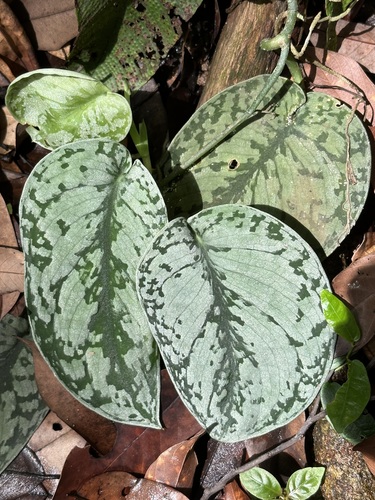
satin pothos (Scindapsus pictus)
Scindapsus pictus is an evergreen climbing vine that can attach to supports with aerial roots or grow trailing.
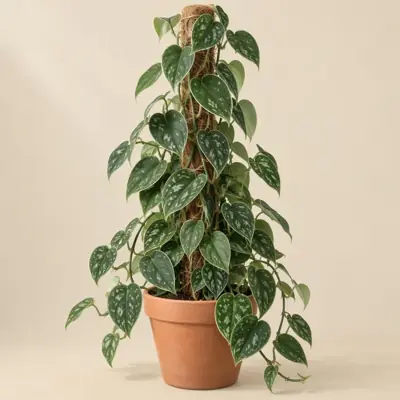
Overview
Scindapsus pictus is an evergreen climbing vine that can attach to supports with aerial roots or grow trailing.
Origin and habitat
It is native from South Asia to Southeast Asia, including Bangladesh, India, Thailand, Peninsular Malaysia, Borneo, Java, Sumatra, Sulawesi, the Philippines, and Taiwan; another account summarizes its range as extending from southeastern Bangladesh to the western and central Malay Archipelago. In its native habitat it grows attached to tree trunks by root-like attachment structures and can also climb rocks and other solid surfaces. It is a tropical plant suited to warm conditions and is grown mainly as an indoor plant in temperate regions.
Characteristics
Sources differ on mature height, placing it at about 150–300 cm, while the few evidence available reports a mature spread of about 50–100 cm. Growth tends to be slow, although vines can grow faster when provided with suitable climbing support. Juvenile leaves are ovate with heart-shaped bases and entire margins, green to dark green with silver-gray markings above and a paler, unmarked underside; mature leaves may remain entire or become pinnately divided, while 'Argyraeus' has smaller dark-green to pine-green leaves with fewer silver markings and is also described as having silver leaf margins. The small, inconspicuous flowers are borne on a spadix surrounded by a spathe and rarely appear indoors or in cultivation; they are reported to appear in summer mainly on outdoor plants, and small berries may form afterward but are rarely produced by indoor plants.
Light
Sources describe light conditions differently: indoor plants are suited to bright indirect light and should be protected from hot direct sunlight, while another source also lists full-sun, east-facing, or south-facing sheltered positions.
Watering
During active growth, water moderately and keep the growing medium moist but well drained; reduce watering at other times.
Temperature and dormancy
The ideal temperature range is 18–25 °C. Limited single-source information reports a minimum of about 15 °C and a maximum of about 29.4 °C.
Growing medium and mounting
For containers, use a moist but well-drained growing medium; recommendations include a peat-free, loam-based medium, with loam or sandy soil and acidic, neutral, or alkaline conditions all listed as suitable. The plant has mainly aerial roots.
Feeding
A balanced liquid fertilizer is reported to be suitable regularly during the growing period.
Propagation
Propagation is by stem or tip cuttings, and root division can also be used in cultivation.
Common problems
Sources differ on pests: scale insects, mites, mealybugs, and thrips are listed as possible pests, while another source describes the plant as generally free of significant pest problems. Sources also differ on diseases: fungal leaf spot, gray mold, and root rot associated with poor drainage or overly wet soil are listed as possible problems, while another source describes the plant as generally free of significant disease problems. Yellow leaves are reported to be a possible sign of overwatering, curled leaves a possible sign of insufficient water, and overly wet or poorly drained growing medium a possible cause of root rot. It does not tolerate frost or colder conditions and should also be protected from very hot direct sunlight.
Identification
'Argyraeus' is a cultivar of Scindapsus pictus distinguished by smaller dark-green to pine-green leaves with silver markings; the species itself has aerial roots that attach to substrates and silver-gray mottling on the leaf surface.
Photos