
Coppertone Stonecrop (Sedum adolphii)
Sedum adolphi is a low-growing, branching, shrubby succulent that can trail or spread. It is an evergreen perennial.
Overview
Sedum adolphi is a low-growing, branching, shrubby succulent that can trail or spread. It is an evergreen perennial.
Origin and habitat
Sources differ on its native range, with Mexico and, more specifically, Veracruz recorded. Sources differ in describing its habitat as rocky terrain and cliff faces.
Characteristics
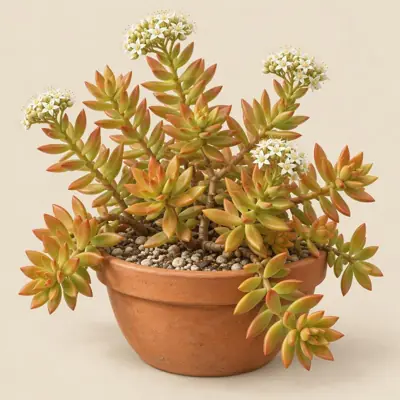
Mature plants reach 10–50 cm in height, while the few sources for spread report about 50–100 cm. It is reported to grow quickly and stores water in its leaves. Its evergreen, fleshy leaves range from olive green and greenish yellow to golden yellow, developing orange-copper or red tones or red-orange margins in ample sunlight; the leaves may be lance-shaped and arranged spirally along the stems. The small, star-shaped flowers are mainly white and may form inflorescences; some sources report fragrance and others describe them as white to yellow, while sources differ on flowering from late winter into spring.
Light
Full sun is preferred, while indoor plants need bright light; ample sunlight can encourage red, orange, or golden-red leaf tones, and the plant takes full sun.
Watering
It is reported to need little water and a well-drained medium; generally, watering can wait until the surface has dried, with water greatly reduced during dormancy and prolonged wetness avoided.
Humidity and airflow
It is reported to need good airflow.
Temperature and dormancy
The few sources indicate a cold minimum of about 0 °C; it is generally reported as frost tender and should be kept above freezing. It is generally reported for the stated USDA hardiness designation, and dormancy varies. It is reported to prefer ventilation in high temperatures, while excessively strong summer sun may cause leaf scorch and overheating.
Growing medium and mounting
It needs a fast-draining mix and well-drained soil; RHS recommends moderately fertile, neutral to alkaline chalky, loamy, or sandy soil.
Feeding
A small amount of slow-release chemical fertilizer or liquid fertilizer is reported to be suitable during spring and autumn growth.
Propagation
It can be propagated by leaf cuttings, stem cuttings, or seed, with RHS specifically recommending softwood cuttings in early summer.
Common problems
It is reported to be susceptible to mealybugs, scale insects, and weevils. Sources differ on fungal or bacterial crown and root rots, and poor drainage or airflow is reported to warrant attention to crown and root rot. It is sensitive to severe frost, freezing, and cold, wet winters; good airflow is preferred in high temperatures.
Identification
Its fleshy leaves shift from greenish yellow or golden yellow toward orange-copper to red tones in strong light, accompanied by small, star-shaped white flowers.
Photos


Sources
- Wikipedia (en): Sedum adolphi — CC BY-SA 4.0 · link
- Wikipedia (es): Sedum adolphii — CC BY-SA 4.0 · link
- RHS Plants: Sedum adolphi — © RHS, facts only · link
- The Succulent Plant Page: Sedum (genus-level) — © R.J. Hodgkiss, facts only · link
- NHK みんなの趣味の園芸 植物図鑑: Sedum (genus-level) — © NHK出版, facts only · link
- Top Tropicals catalog: Sedum adolphi — © Top Tropicals LLC (facts only) · link
- Sedum adolphii | Giromagi cactus and succulents for sale | Buy plants online (www.giromagi.com) — facts only (§12) · link
- PUKUBOOK: Sedum adolphi — CC BY-NC (facts only) · link