
Sedum clavatum (Sedum clavatum)
Sedum clavatum is a small succulent that forms tight rosettes, branches and clusters, and gradually spreads outward into mats as its stems elongate and become creeping. Sources differ on its life cycle; one account describes it as annual.
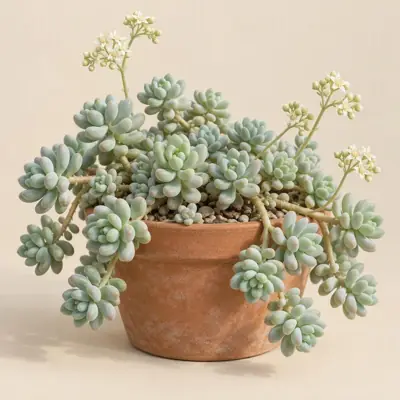
Overview
Sedum clavatum is a small succulent that forms tight rosettes, branches and clusters, and gradually spreads outward into mats as its stems elongate and become creeping. Sources differ on its life cycle; one account describes it as annual.
Origin and habitat
Sedum clavatum is native to Mexico, with more precise records restricting its known native range to the Tiscalatengo River canyon near Villa Guerrero, southeast of Nevado de Toluca in southern State of Mexico, within the Trans-Mexican Volcanic Belt. It is reported from canyon rock walls and cliff environments. It is suited to semiarid to arid environments and has strong drought tolerance in cultivation.
Characteristics
Sources differ on mature height, with figures of about 0–10 cm, while the few available sources report a mature spread of about 10–50 cm. It is reported to branch and produce basal offsets, spreading over time into clumps or mats. The thick, club-shaped leaves curve slightly upward and have a powdery blue-green to creamy-blue surface; their tips can turn pink in strong light or low temperatures, and the plant stores water in its leaves. The small, star-shaped flowers open white and may become pinkish as they age, with sepals that can have pink tips; sources differ somewhat on flowering season, placing it in spring and mainly from mid-to-late spring into early summer.
Light
Sedum clavatum needs bright conditions, but sources differ over whether full sun or light shade is best: RHS recommends full sun, while LLIFLE favors well-ventilated light shade, notes that ample light helps prevent elongated growth, and reports that full sun can be suitable in cool coastal conditions. It tolerates bright light or part shade.
Watering
Water after the growing medium dries; moderate moisture during the growing season can support stronger growth, but standing water and overwatering should be avoided, watering should be reduced in winter, and the plant tolerates prolonged drought.
Humidity and airflow
It is reported to prefer low humidity and need good airflow.
Temperature and dormancy
Sources differ on the lower temperature limit, with figures around -3 °C, while supported accounts give a cold minimum of -3 °C and indicate that the plant tolerates brief light frost. It is reported as RHS H3, and dormancy varies. It is reported to be less robust in hot, humid conditions, with summer protection from rain, good ventilation, and partial shade advised.
Growing medium and mounting
Use a porous, fast-draining, well-drained growing medium; Sedum clavatum can adapt to chalk, loam, or sandy soil and to acidic, neutral, or alkaline conditions, has shallow roots, and can have a moderate amount of organic matter in the medium. It is reported to be prone to rot and to need a fast-draining mix.
Feeding
A slow-release fertilizer low to moderate in nitrogen can be used in the growing medium to support spring and summer growth; RHS also recommends half-strength liquid fertilizer monthly during the growing season.
Propagation
Sedum clavatum can be propagated by seed, division, stem cuttings, and leaves; spring is suitable for cuttings, and detached or removed leaves may root on the surface of the growing medium and form new plants.
Common problems
Potential pests include aphids, slugs, snails, weevil larvae, scale insects, and mealybugs. Fungal or bacterial crown and root rots may occur, and prolonged standing water increases the risk of root rot. Insufficient light or excessive fertilizer can cause elongated, weak, paler growth, while overwatering or standing water can lead to root rot. It is drought tolerant but has limited cold tolerance, and excessively wet conditions should especially be avoided when it is cold.
Identification
Sedum clavatum is distinguished by tight, powdery blue-green succulent rosettes with club-shaped leaves whose tips can turn pink in strong light or cold conditions; older plants develop lengthening stems and form creeping colonies.
Photos


Sources
- Wikipedia (en): Sedum clavatum — CC BY-SA 4.0 · link
- Wikipedia (fr): Sedum clavatum — CC BY-SA 4.0 · link
- LLIFLE Encyclopedia of living forms: Sedum clavatum — CC BY-SA · link
- RHS Plants: Sedum clavatum — © RHS, facts only · link
- The Succulent Plant Page: Sedum (genus-level) — © R.J. Hodgkiss, facts only · link
- NHK みんなの趣味の園芸 植物図鑑: Sedum (genus-level) — © NHK出版, facts only · link
- Sedum clavatum | Giromagi cactus and succulents for sale | Buy plants online (www.giromagi.com) — facts only (§12) · link
- PUKUBOOK: Sedum clavatum — CC BY-NC (facts only) · link