
golden Japanese sedum (Sedum makinoi)
Sedum makinoi is an evergreen perennial succulent with a creeping, ground-covering habit that can form dense mats; growing stems can root, while some shoots grow upward.
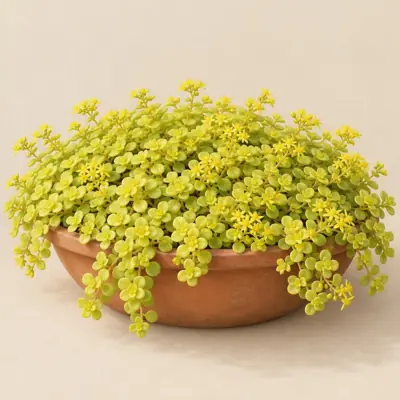
Overview
Sedum makinoi is an evergreen perennial succulent with a creeping, ground-covering habit that can form dense mats; growing stems can root, while some shoots grow upward.
Origin and habitat
Sources differ on its native range: it is native to East Asia, including Japan, eastern China and Taiwan, while another source also lists Korea. Sources differ on its habitat, describing shaded, moist forests in low mountain valleys, crevices in high-mountain rocks, and sunny positions in forests or other natural areas. It tolerates drought and heat and has some cold tolerance when dormant; in regions with hot summers, avoiding strong midday sun is suitable.
Characteristics
Sources differ on mature height, with the few available accounts indicating about 5–10 cm, while mature spread is 30–50 cm. The leaves are small, nearly round and succulent, and 'Ogon' has bright golden-yellow foliage and is reported to establish ground cover quickly. It is reported to produce yellow to yellow-green flowers in summer. It is reported to store water in its leaves.
Light
Sources differ somewhat on light conditions: it can grow in full sun to partial sun, while indoors it needs bright direct light and can receive some midday shade in regions with hot summers. It takes full sun.
Watering
Use a well-drained medium; established plants tolerate drought and generally do not need frequent watering, though they can also grow in moister soil where drainage is good. Container plants can receive more water during the growing season, with watering reduced in winter, while waterlogging and poor drainage should be avoided.
Temperature and dormancy
Sources differ on the lower temperature limit, with the few available accounts indicating about -15 °C. It is generally listed as RHS H2, reported to be frost hardy, and its dormancy is reported to vary. It is weaker under hot, humid conditions, and afternoon shade is suitable during hot summers.
Growing medium and mounting
It favors a well-drained medium and can be grown in coarse or cactus-type mixes; it can adapt to loam, sand and chalky soils. It prefers fertile, well-drained soil that can be somewhat dry, with RHS listing neutral to alkaline conditions, and it needs a fast-draining mix.
Feeding
Small amounts of fertilizer can be applied during growth; RHS recommends diluted liquid fertilizer during the growing season, while NHK guidance for Sedum recommends small amounts of slow-release fertilizer or liquid fertilizer during spring and autumn growth.
Propagation
Sedum makinoi can be propagated by cuttings, and fallen leaves of the species can also form new plants. Sedum guidance also lists division, stem cuttings, leaf cuttings and seed propagation for the species.
Common problems
Potential pests include slugs, snails, weevil larvae, scale insects and mealybugs; Sedum cultivation information also mentions aphids and root mealybugs. Fungal or bacterial crown and root rots can occur, while NCSU also lists southern blight of herbaceous ornamentals but indicates that serious pest and disease problems are generally absent. Waterlogging or poor drainage is a major cultivation risk, and the leaves can detach easily. It tolerates drought and heat, but hot regions favor protection from strong midday light; some information also recommends ventilation, shelter from rain and controlled moisture during hot, humid periods, while accounts of low-temperature tolerance differ by source and growing context.
Identification
'Ogon' is a low, spreading ground-cover cultivar distinguished by small, bright golden-yellow leaves that form dense mats.
Photos


Sources
- 維基百科:圆叶景天 — CC BY-SA 4.0 · link
- Wikipedia (en, genus): Sedum — CC BY-SA 4.0 · link
- NC State Plant Toolbox: Sedum makinoi — copyright (facts only) · link
- TaiCOL 臺灣物種名錄: Sedum makinoi — CC BY 4.0 · link
- Useful Tropical/Temperate Plants: Sedum makinoi — CC BY-NC-SA 3.0 (facts only) · link
- RHS Plants: Sedum makinoi — © RHS, facts only · link
- The Succulent Plant Page: Sedum (genus-level) — © R.J. Hodgkiss, facts only · link
- NHK みんなの趣味の園芸 植物図鑑: Sedum (genus-level) — © NHK出版, facts only · link
- PUKUBOOK: Sedum makinoi — CC BY-NC (facts only) · link