
Donkeytail (Sedum morganianum)
Sedum morganianum is an evergreen perennial succulent with long stems that become trailing as they extend, although young growth may be more compact and upright, making the plant suited to hanging growth.
Overview
Sedum morganianum is an evergreen perennial succulent with long stems that become trailing as they extend, although young growth may be more compact and upright, making the plant suited to hanging growth.
Origin and habitat
Sources differ on accounts of its native range; it is native to Mexico, with documented wild populations around Tenampa in central Veracruz. A single source reports wild plants growing on vertical igneous-rock canyon walls in Veracruz within tropical deciduous forest, with a very restricted distribution. Records from its native habitat involve tropical deciduous forest, while in cultivation it is frost-sensitive and suited to warm conditions.
Characteristics
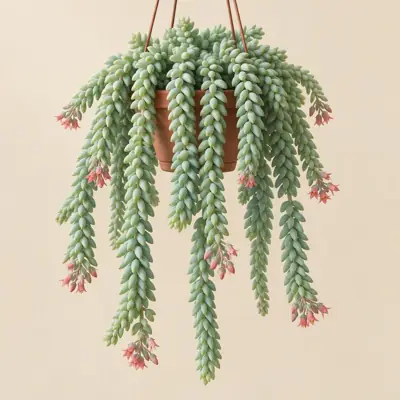
Sources differ on mature height, placing it at about 10–50 cm, while a single source reports a mature spread of about 10–50 cm. The fleshy, blue-green to gray-blue-green leaves are densely arranged along the stems and may be lance-shaped, triangular, or more rounded and elongated; they can have a waxy white coating and are loosely attached, so they detach easily when touched. Small, star-shaped flowers appear in clusters at stem tips and range from pale pink and pink to red and reddish purple; sources differ on the flowering period, describing it as late spring through summer. It stores water in its leaves and is reported to establish relatively quickly under suitable conditions.
Light
Sources differ on light recommendations, describing bright conditions through full sun; indoors, a bright window with sunlight is suitable, while outdoors it may grow in full sun to part shade but should be sheltered from the strongest periods of exposure. It tolerates bright light or part shade.
Watering
Use a well-drained medium and allow it to dry after watering before watering again; provide moderately regular water during growth, reduce watering markedly in winter, and avoid prolonged wetness, standing water, and overwatering.
Humidity and airflow
It needs good airflow.
Temperature and dormancy
The minimum temperature is 5 °C. Sources differ on its hardiness-zone classification; it is generally described as frost tender and should be kept above freezing. Dormancy is reported to vary. It should be sheltered during extreme heat and is less tolerant of hot, humid conditions.
Growing medium and mounting
It needs a well-drained medium; options include a peat-substitute loam medium amended with horticultural grit, and it can also adapt to sandy, chalky, rocky, or relatively poor soils, with neutral to alkaline pH described as suitable. It is prone to rot and needs a fast-draining mix.
Feeding
Feed lightly during the growing season, using small amounts of fertilizer.
Propagation
It can be propagated from stem and leaf cuttings, and detached leaves root readily; propagation by sowing seed or division is also recorded. Supported propagation methods include leaf cuttings, stem cuttings, and division.
Common problems
Potential pests include weevil larvae, scale insects, mealybugs, and occasional slugs and snails. Fungal or bacterial crown rot and root rot may occur, and overwatering or poor drainage increases the risk of disease and rot; southern blight of herbaceous ornamentals has also been recorded. The leaves are very fragile and can detach during handling, touching, or rain impact, while overwatering or poorly drained medium can quickly cause rot. It does not tolerate frost and requires frost protection outdoors; extreme heat and excessive rainfall should also be avoided, as heavy rain can dislodge the fragile leaves.
Identification
Long, trailing succulent stems densely covered with fleshy leaves create a bead-like or curtain-like appearance; the stems and leaves have a conspicuous waxy white coating, and the leaves detach very easily when touched.
Photos


Sources
- GBIF Backbone: Sedum morganianum Walther — CC BY 4.0 · link
- Wikipedia (en): Sedum morganianum — CC BY-SA 4.0 · link
- Wikipedia (de): Sedum morganianum — CC BY-SA 4.0 · link
- Wikipedia (fr): Sedum morganianum — CC BY-SA 4.0 · link
- Wikipedia (es): Sedum morganianum — CC BY-SA 4.0 · link
- NC State Plant Toolbox: Sedum morganianum — copyright (facts only) · link
- RHS Plants: Sedum morganianum — © RHS, facts only · link
- Desert-Tropicals: Sedum morganianum — © Philippe Faucon (desert-tropicals.com), facts only · link
- The Succulent Plant Page: Sedum (genus-level) — © R.J. Hodgkiss, facts only · link
- NHK みんなの趣味の園芸 植物図鑑: Sedum morganianum — © NHK出版, facts only · link
- Top Tropicals catalog: Sedum morganianum — © Top Tropicals LLC (facts only) · link
- Sedum morganianum | Giromagi cactus and succulents for sale | Buy plants online (www.giromagi.com) — facts only (§12) · link
- PUKUBOOK: Sedum morganianum — CC BY-NC (facts only) · link