
blue spikemoss (Selaginella uncinata)
Selaginella uncinata is low-growing and creeping to trailing, with stems that can root and form dense mats. Sources differ in describing its life cycle as perennial. It is reported to be terrestrial.
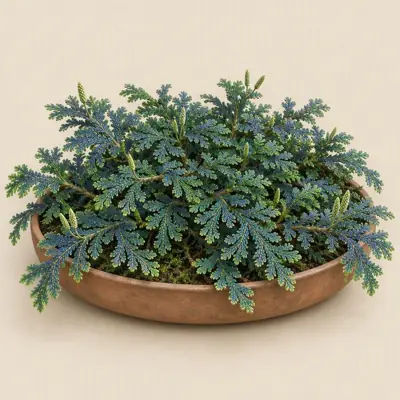
Overview
Selaginella uncinata is low-growing and creeping to trailing, with stems that can root and form dense mats. Sources differ in describing its life cycle as perennial. It is reported to be terrestrial.
Origin and habitat
Sources differ in reporting its native range as southern China. In southern China it occurs beneath forest cover; in horticultural conditions it suits shaded, woodland-like environments and can form dense carpet-like colonies. It is reported for moist, shaded environments and is described by the source as tropical and suitable for a stated range of USDA zones.
Characteristics
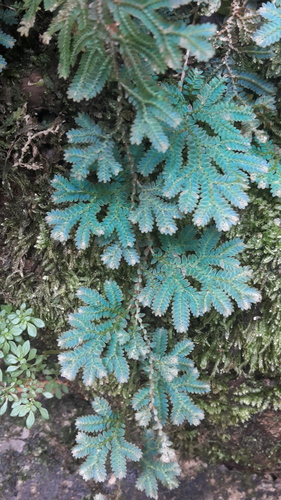
Sources differ, with the few available reports placing mature height at about 0–10 cm. A limited source reports a mature spread of about 10–50 cm. Sources differ in describing it as fast-growing and vigorous. Its small leaves are arranged densely in a moss-like pattern, giving the plant a blue-green to metallic blue-green appearance; blue or iridescent tones may become more apparent in low light. It is reported not to flower.
Light
It suits deep shade to partial sun, with bright indirect light or partial shade preferred, and strong direct sunlight should be avoided. It tolerates shade.
Watering
Keep the growing medium moist, but do not leave container-grown roots standing in water for prolonged periods; in winter, watering can wait until the surface has dried. Keep evenly moist.
Humidity and airflow
It is reported to prefer high humidity and to have a high humidity need.
Temperature and dormancy
A limited source reports a minimum temperature of about 5 °C. It is reported to have an RHS hardiness classification. It is frost tender; keep above freezing. It is reported to be tender.
Growing medium and mounting
Sources differ, but describe a preference for moist, humus-rich growing medium; loamy or clayey soil can be used, while RHS guidance favors neutral to acidic conditions and container media that provide both drainage and aeration.
Feeding
Sources differ, but fertilizer needs are described as low; when feeding, diluted liquid fertilizer can be used early in growth, while RHS greenhouse guidance recommends regular feeding during part of the year.
Propagation
It can be propagated by division, stem cuttings, or spore; rooting at the tips of leafy stems can also facilitate division or cutting propagation. Spore is reported to form in short terminal spike-like structures and can be used for propagation. It can be propagated by division, with lush plants divided into separate plants for planting.
Common problems
Slugs and snails may damage the plant. It generally has few notable disease problems. Strong direct light may scorch the leaves, dry conditions are unfavorable for growth, and container-grown roots should not remain standing in water for prolonged periods. In cold regions, outdoor plants need winter protection or can be moved indoors in containers for overwintering; other information indicates some degree of cold tolerance.
Identification
Its most conspicuous features are iridescent blue-green leaf surfaces and a creeping, trailing growth habit that forms dense mats.
Photos


Sources
- Wikipedia (en): Selaginella uncinata — CC BY-SA 4.0 · link
- 維基百科:翠云草 — CC BY-SA 4.0 · link
- Wikipedia (ja): コンテリクラマゴケ — CC BY-SA 4.0 · link
- Wikipedia (es): Selaginella uncinata — CC BY-SA 4.0 · link
- NC State Plant Toolbox: Selaginella uncinata — copyright (facts only) · link
- TaiCOL 臺灣物種名錄: Selaginella uncinata — CC BY 4.0 · link
- RHS Plants: Selaginella uncinata — © RHS, facts only · link
- USDA PLANTS Database: Selaginella uncinata — Public domain (US Government work) · link
- NHK みんなの趣味の園芸 植物図鑑: Selaginella uncinata — © NHK出版, facts only · link
- Selaginella: The Spikemoss Guide for Growing, Choosing & Using It (terrariumtribe.com) — facts only (§12) · link
- Selaginella Uncinata - Buce Plant (buceplant.com) — facts only (§12) · link