
common houseleek (Sempervivum tectorum)
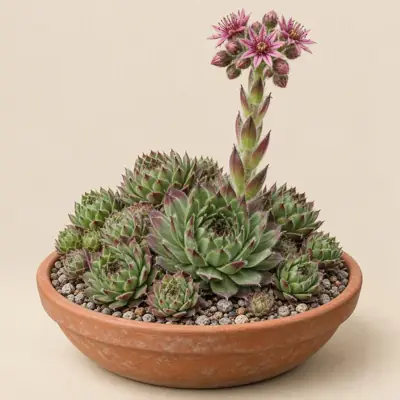
Sempervivum tectorum is an evergreen perennial succulent herb that forms rosettes, grows in clumps or mats, and spreads outward through lateral rosettes. It is perennial, but each individual rosette flowers once and dies after flowering and fruiting, while its lateral rosettes can continue growing.
Overview
Sempervivum tectorum is an evergreen perennial succulent herb that forms rosettes, grows in clumps or mats, and spreads outward through lateral rosettes. It is perennial, but each individual rosette flowers once and dies after flowering and fruiting, while its lateral rosettes can continue growing.
Origin and habitat
Sources differ on the native range: it is mainly described from mountainous areas of southern Europe, from the Pyrenees eastward through the Alps, Apennines, and Balkans, while broader accounts describe it simply as European. It inhabits sunny, fast-draining mountain rock slopes, crevices, rocky surfaces, dry grassland, and shallow soils, and also occurs on roofs, old walls, and gaps in buildings. It is associated with temperate mountain environments and favors sunny, relatively dry, fast-draining conditions while tolerating drought and low temperatures.
Characteristics
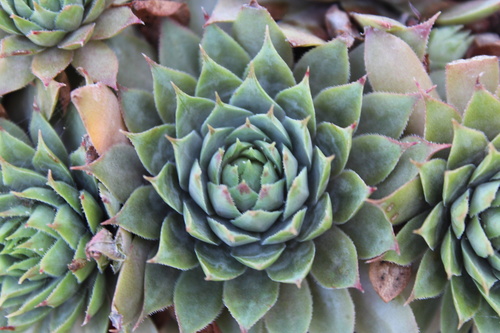
Sources differ on mature size, with height reported at about 10–15 cm and spread at about 10–50 cm. It continually produces lateral young rosettes that spread outward into colonies, and its fleshy leaves form dense rosettes and store water in the leaves. The leaves range from oblong and lanceolate to oblanceolate, are often green, gray-green, or blue-green with red, purplish-red, or brownish-purple tips or margins, and have conspicuous fine marginal hairs and pointed or shortly tipped ends. Sources differ in descriptions of the variable petal count; the flowers are star-shaped or radially symmetrical, usually pink, reddish-purple, or purple, and clustered in terminal, relatively flat inflorescences on upright, usually hairy flowering stems, with flowering in summer and sometimes extending into early autumn; the fruit is a follicle, and the parent rosette dies after fruiting.
Light
It takes full sun, and sources differ on shading: full sun is described as best, with some shade tolerated and moderate afternoon shade possible in extremely hot locations with intense sunlight.
Watering
It tolerates drought; the growing medium should dry moderately between waterings, while overwatering and prolonged waterlogging should be avoided, especially in winter.
Humidity and airflow
It is generally reported to need good airflow and prefer low humidity.
Temperature and dormancy
Sources differ on a reported lower temperature of about -12 °C, while the reported upper temperature is about 38 °C and is based on few sources. A specialist-supported cold minimum is -12 °C, and the plant is frost hardy. Sources differ on its hardiness-zone classification, and dormancy is generally reported to vary. It has weaker heat tolerance, and excessively strong sunlight should be avoided in high temperatures or hot climates.
Growing medium and mounting
It grows in well-drained sandy, gravelly, or loamy soil and can grow in poor, shallow soil in rock crevices; prolonged wetness should be avoided, and it can adapt to acidic, neutral, or alkaline soil. It needs a fast-draining mix and is prone to rot.
Feeding
It is reported that small amounts of slow-release chemical fertilizer or liquid fertilizer can be applied during spring and autumn growth periods.
Propagation
The most common propagation method is separating and replanting lateral young rosettes; seed propagation can also be done in spring, and the lateral rosettes root readily and form new colonies. Supported propagation methods include division, cuttings, and seed.
Common problems
Scale insects, aphids, and root mealybugs are reported as possible pests. Overwatering can cause crown or root rot, while general cultivation sources do not identify other especially prominent diseases. The main cultivation problem is rot associated with poor drainage or excessive watering; prolonged winter wetness and hot, humid summer conditions are also unfavorable. It tolerates cold and some drought but is more sensitive to excessive winter wetness and hot, humid conditions; moderate shade is suitable under extremely hot, intensely sunny conditions.
Identification
Sempervivum tectorum forms rosettes of tightly packed fleshy leaves with ciliate margins and often reddish-purple tips, produces many lateral young rosettes that form colonies, and has individual mature rosettes that die after flowering.
Photos


Sources
- Wikipedia (en): Sempervivum tectorum — CC BY-SA 4.0 · link
- 維基百科:屋顶长生草 — CC BY-SA 4.0 · link
- Wikipedia (de): Dach-Hauswurz — CC BY-SA 4.0 · link
- Wikipedia (fr): Joubarbe des toits — CC BY-SA 4.0 · link
- Wikipedia (es): Sempervivum tectorum — CC BY-SA 4.0 · link
- GBIF descriptions: Manual of the Alien Plants of Belgium; Database of Vascular Plants of Canada (VASCAN); Checklist of — per dataset · link
- NC State Plant Toolbox: Sempervivum tectorum — copyright (facts only) · link
- LLIFLE Encyclopedia of living forms: Sempervivum tectorum — CC BY-SA · link
- Useful Tropical/Temperate Plants: Sempervivum tectorum — CC BY-NC-SA 3.0 (facts only) · link
- RHS Plants: Sempervivum tectorum — © RHS, facts only · link
- USDA PLANTS Database: Sempervivum tectorum — Public domain (US Government work) · link
- Desert-Tropicals: Sempervivum tectorum — © Philippe Faucon (desert-tropicals.com), facts only · link
- The Succulent Plant Page: Sempervivum (genus-level) — © R.J. Hodgkiss, facts only · link
- NHK みんなの趣味の園芸 植物図鑑: Sempervivum (genus-level) — © NHK出版, facts only · link