
garden tomato (Solanum lycopersicum)
Solanum lycopersicum is an herbaceous plant that may grow upright, spreading, climbing, or eventually trailing. Sources differ on whether it is annual or perennial; in cultivation it is often grown as an annual but can persist as a perennial in suitable warm conditions.
Overview
Solanum lycopersicum is an herbaceous plant that may grow upright, spreading, climbing, or eventually trailing. Sources differ on whether it is annual or perennial; in cultivation it is often grown as an annual but can persist as a perennial in suitable warm conditions.
Origin and habitat
Sources differ in describing its native range, associating it with western South America, especially the Andes and surrounding regions, while its later domestication and diversification are closely associated with Mexico and Central America. Its original wild habitat is reported to be unclear, with no definite record of a truly wild habitat. It is suited to cultivation in tropical, subtropical, and temperate conditions; in temperate regions it is also commonly grown under protection, and it does not tolerate frost.
Characteristics
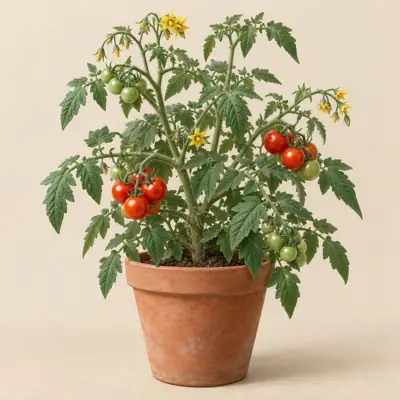
Sources differ, but mature height is reported at about 150–250 cm; the available sources are few. A limited source reports a mature spread of about 50–100 cm. The leaves are compound, often odd-pinnate or deeply divided; leaflet number and form vary among cultivars and systems, and the leaves and stems may be hairy. The yellow flowers are radial or star-shaped and can self-fertilize, while the fleshy botanical berries are usually green when immature and commonly red or yellow when mature, with other colors also occurring and with size, shape, and color varying greatly among cultivars.
Light
Full sun is suitable, while some sources also describe cultivation in bright indoor light or partial shade.
Watering
Water regularly, keeping the growing medium evenly moist but well drained; another source recommends regular watering after the surface has dried slightly.
Temperature and dormancy
Sources differ, but a lower temperature of about 7 °C is reported; the available sources are few. A limited source reports an ideal temperature range of about 20–27 °C and a maximum of about 35 °C. Sources differ on its USDA hardiness-zone classification. It is reported to tolerate brief light frost.
Growing medium and mounting
It is reported to grow in clay, loam, or sandy soil, with moist, well-drained soil preferred and an acidic to neutral soil reaction.
Feeding
It is reported to benefit from regular balanced liquid fertilizer early in growth, changing to a high-potassium liquid fertilizer after the first fruits have set.
Propagation
Seedlings can reportedly be started from seed.
Common problems
It may be affected by various insect pests and nematodes, including root-knot nematodes. Common disease types include late blight, early blight, gray mold, leaf spot, bacterial wilt, wilt diseases, bacterial spot, canker, and various tomato virus diseases. Other cultivation problems are reported to include blossom-end rot. It is sensitive to or intolerant of frost, and frost risk should be avoided when moving it outdoors for cultivation.
Identification
Solanum lycopersicum is an herbaceous tomato plant whose stems and leaves are often hairy, with yellow flowers and fleshy berries; its growth habit may be determinate or indeterminate.
Photos


Sources
- Wikipedia (en): Tomato — CC BY-SA 4.0 · link
- 維基百科:番茄 — CC BY-SA 4.0 · link
- Wikipedia (ja): トマト — CC BY-SA 4.0 · link
- Wikipedia (de): Tomate — CC BY-SA 4.0 · link
- Wikipedia (es): Solanum lycopersicum — CC BY-SA 4.0 · link
- GBIF descriptions: Manual of the Alien Plants of Belgium; Checklist of introduced taxa in Cyprus; Database of Vascular — per dataset · link
- NC State Plant Toolbox: Solanum lycopersicum — copyright (facts only) · link
- Useful Tropical/Temperate Plants: Solanum lycopersicum — CC BY-NC-SA 3.0 (facts only) · link
- RHS Plants: Solanum lycopersicum — © RHS, facts only · link
- USDA PLANTS Database: Solanum lycopersicum — Public domain (US Government work) · link
- Top Tropicals catalog: Solanum lycopersicum — © Top Tropicals LLC (facts only) · link