
aubergine (Solanum melongena)
Solanum melongena is an upright, much-branched herb to subshrub; its stems may bear spines, although some cultivars are spineless. Sources describe its life cycle differently: it may be perennial or short-lived perennial, but it is often grown as an annual and is usually treated as an annual in temperate regions.
Overview
Solanum melongena is an upright, much-branched herb to subshrub; its stems may bear spines, although some cultivars are spineless. Sources describe its life cycle differently: it may be perennial or short-lived perennial, but it is often grown as an annual and is usually treated as an annual in temperate regions.
Origin and habitat
Sources differ on its native range within Asia, variously pointing to South Asia, Southeast Asia, the eastern Indian subcontinent, or an area extending from south-central China to Indochina. Its wild habitat has not been confirmed, and it is now a widely cultivated crop. It favors warm to hot conditions, is suited to tropical, subtropical, and warm-season cultivation, and does not tolerate cold well.
Characteristics
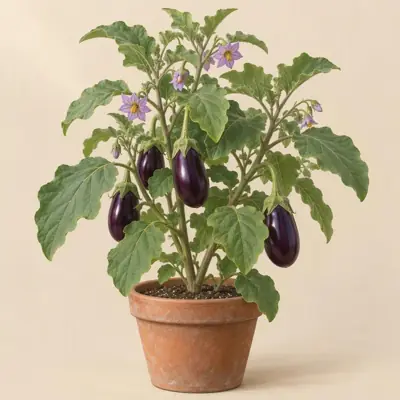
Sources differ on mature height, placing it at about 60–150 cm, while the few available sources report a mature spread of about 50–100 cm. It is reported to grow quickly; its alternate leaves are commonly ovate to oblong-ovate with wavy or shallowly lobed margins, and the leaves and stems may bear stellate hairs. Flowers range from white to purple, with a usually lobed corolla and conspicuous yellow stamens, and commonly open facing downward; flowering is reported to occur from summer to autumn. The fruit is botanically a berry and varies greatly among cultivars in shape and color, including ovate, elongated, round, elliptical, or pear-shaped forms; it is commonly purple, with white and green types also occurring, and contains many small seeds.
Light
It favors full sun and a well-lit position, and ample light is also needed for good fruit coloration.
Watering
It does not tolerate dry conditions and needs consistent moisture during growth; the soil should remain moist but well drained, while excessive rainfall may reduce growth and flowering.
Temperature and dormancy
The few available sources report a lower temperature of about 10 °C. The ideal temperature is 25–30 °C.
Growing medium and mounting
It is generally reported to favor fertile, moisture-retentive but well-drained soil and can grow in loam, clay, sand, or chalk, with soil conditions ranging from acidic to alkaline.
Feeding
It has high fertility requirements and needs supplemental feeding during growth and fruiting.
Propagation
It is propagated by seed; grafted plants are also commonly used in cultivation to increase disease resistance.
Common problems
Potential pests include aphids, whiteflies, spider mites including two-spotted spider mites, scale insects, flea beetles, and some plant-feeding lady beetles. Potential diseases include bacterial wilt, wilt diseases, and diseases associated with Armillaria. Continuous cropping can cause notable problems; insufficient light can impair fruit coloration, dry conditions can affect growth, and excessive rainfall can slow growth and reduce flowering. It is sensitive to low temperatures, frost, and dry conditions and favors hot conditions.
Identification
Typical identifying features include an upright, branching habit, stellate hairs, stems that may bear spines, purple-toned flowers, and glossy fleshy fruits; fruit shape and color vary greatly among cultivars.
Photos


Sources
- Wikipedia (en): Eggplant — CC BY-SA 4.0 · link
- 維基百科:茄 — CC BY-SA 4.0 · link
- Wikipedia (ja): ナス — CC BY-SA 4.0 · link
- Wikipedia (de): Aubergine — CC BY-SA 4.0 · link
- Wikipedia (fr): Aubergine — CC BY-SA 4.0 · link
- Wikipedia (es): Solanum melongena — CC BY-SA 4.0 · link
- GBIF descriptions: The checklist of alien seed plants of D.R. Congo, based on evidence from herbarium collections; Chec — per dataset · link
- NC State Plant Toolbox: Solanum melongena — copyright (facts only) · link
- TaiCOL 臺灣物種名錄: Solanum melongena — CC BY 4.0 · link
- Useful Tropical/Temperate Plants: Solanum melongena — CC BY-NC-SA 3.0 (facts only) · link
- RHS Plants: Solanum melongena — © RHS, facts only · link
- USDA PLANTS Database: Solanum melongena — Public domain (US Government work) · link