
Russian Potato (Solanum tuberosum)
Solanum tuberosum is a perennial herb with underground stolons that form tubers. Sources describe its life cycle differently: the plant is inherently perennial but is usually grown as an annual crop in cultivation.
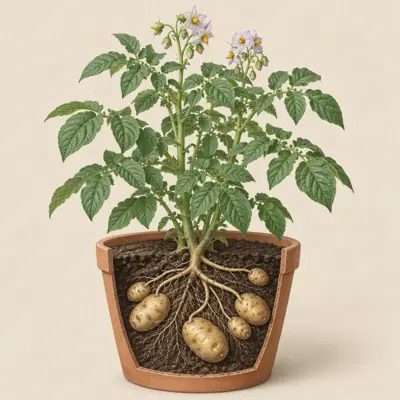
Overview
Solanum tuberosum is a perennial herb with underground stolons that form tubers. Sources describe its life cycle differently: the plant is inherently perennial but is usually grown as an annual crop in cultivation.
Origin and habitat
Sources differ on the native range and center of origin, placing Solanum tuberosum in the Andean region of South America, with the origin of cultivated potatoes more specifically centered from present-day southern Peru to far northwestern Bolivia. Its environment of origin is the middle- and high-elevation Andes of South America, with some sources particularly pointing to the highlands near Lake Titicaca. It is reported to favor cool conditions; in the tropics it is mainly suited to middle and high elevations, with poorer yields at low elevations.
Characteristics
Sources differ on mature size, reporting a height of about 50–100 cm; the few available sources report a spread of about 10–50 cm. The green leaves are compound, usually odd-pinnate, with a terminal leaflet, and their surfaces may bear hairs or trichomes. The star-shaped flowers may be white, pink to red, or purple, and the inflorescences may be terminal. It is reported to form nearly spherical berries that may be green or purplish brown and contain seeds; these fruits are distinct from the potato tubers commonly used as food.
Light
Sources differ in their descriptions, but full sun is specified for cultivation.
Watering
Keep the soil moist but well drained; consistently moderate moisture in light soil can help produce larger, evenly shaped tubers, while waterlogging should be avoided because it can cause tuber rot.
Growing medium and mounting
Solanum tuberosum prefers well-drained soil; NC State specifically recommends sandy, acidic soil, while the RHS records cultivation in clay, loam, and sand and in acidic, neutral, or alkaline conditions.
Propagation
Solanum tuberosum can be propagated vegetatively from the eyes of its tubers.
Common problems
Reported pest problems include potato leafhoppers and other vegetable pests. Important diseases include potato late blight, with other diseases such as southern bacterial wilt also recorded. Poor drainage can cause tuber rot. It is reported to be a crop of cooler environments, and yields may be poorer in tropical lowland conditions.
Identification
Underground stems form starch-rich tubers with eyes from which shoots can emerge for vegetative propagation. The aboveground plant is a hairy herb with compound leaves.
Photos


Sources
- Wikipedia (en): Potato — CC BY-SA 4.0 · link
- 維基百科:马铃薯 — CC BY-SA 4.0 · link
- Wikipedia (ja): ジャガイモ — CC BY-SA 4.0 · link
- Wikipedia (de): Kartoffel — CC BY-SA 4.0 · link
- Wikipedia (fr): Pomme de terre — CC BY-SA 4.0 · link
- Wikipedia (es): Solanum tuberosum — CC BY-SA 4.0 · link
- GBIF descriptions: Manual of the Alien Plants of Belgium; The checklist of alien seed plants of D.R. Congo, based on ev — per dataset · link
- NC State Plant Toolbox: Solanum tuberosum — copyright (facts only) · link
- Useful Tropical/Temperate Plants: Solanum tuberosum — CC BY-NC-SA 3.0 (facts only) · link
- RHS Plants: Solanum tuberosum — © RHS, facts only · link
- USDA PLANTS Database: Solanum tuberosum — Public domain (US Government work) · link